
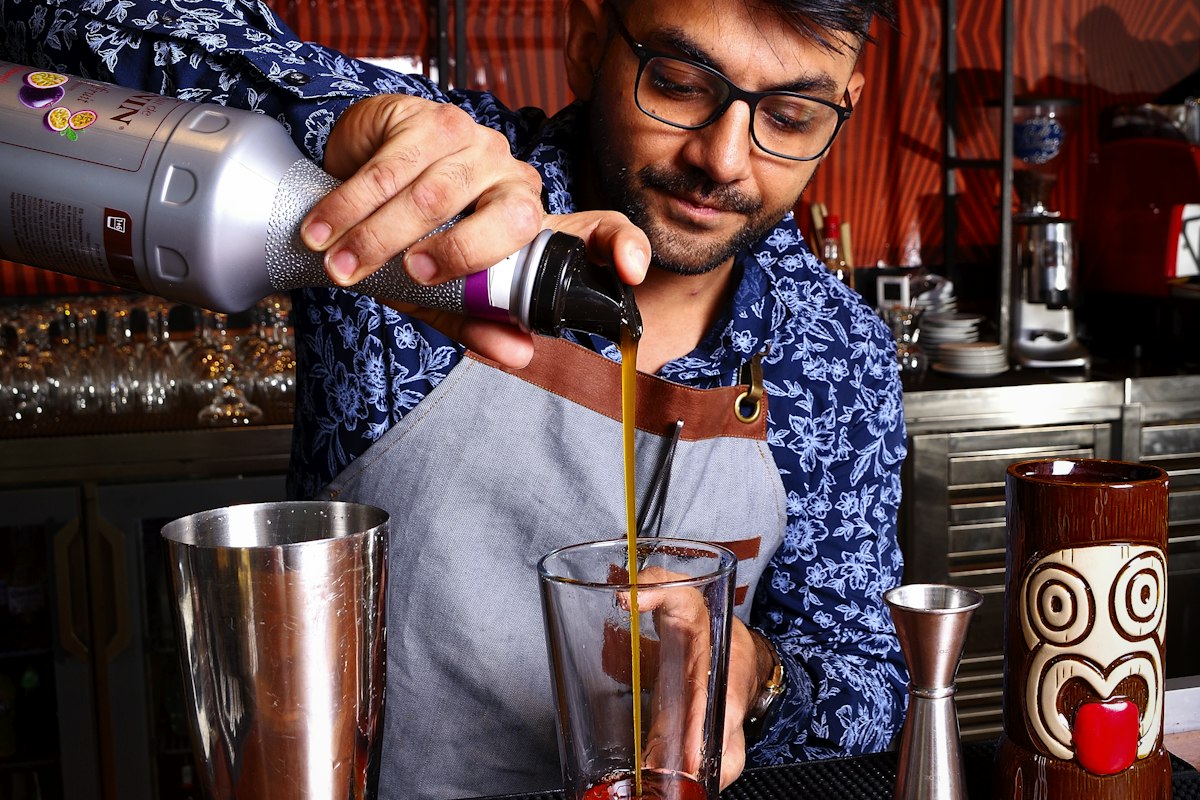
Tiki was invented in Hollywood. In 1933 a man named Ernest Gantt, who later called himself Donn Beach, opened Don the Beachcomber and served rum drinks whose recipes he kept secret. Victor Bergeron followed in Oakland a few years later with Trader Vic's. By the 1960s there were Polynesian-themed bars and restaurants in cities across the country.
Nearly all of them are gone. Since the 1990s a revival has built some very good new bars, and this is not a list of those. These are rooms from the original era that are still pouring, with the people who kept them going. A few have had close calls, and one was shut for four years. All were open at last report.
Tiki-Ti, Los Angeles (1961)
The direct line to the beginning runs through a bar with twelve seats. Ray Buhen was born in the Philippines in 1909 and came to Los Angeles in 1930. According to the Los Angeles Conservancy, he was one of four Filipino bartenders who worked at the original Don the Beachcomber when it opened. In 1961 he opened his own place in a former violin repair shop on Sunset Boulevard.
He tended bar there until he was 88 and died in 1999. His son, Mike Sr., and his grandsons run it now. The menu lists 94 drinks, many of them Ray's own, and there is no beer. The bar closed for a time after a death in the family and reopened in July 2024.
Tonga Hut, North Hollywood (1958)
Two brothers, Ace and Ed Libby, opened the Tonga Hut on Victory Boulevard in 1958, and it has operated ever since, which makes it the oldest tiki bar still going in Los Angeles. New owners bought it in 2005. A second Tonga Hut opened in Palm Springs in 2014.
Tonga Room, San Francisco (1945)
The Fairmont Hotel had an indoor swimming pool, installed in 1929. In 1945 the hotel turned the room into a bar and the pool into a lagoon. The band plays on a boat that floats across it, and at intervals it rains indoors. The city's planning department has named the room a historical resource.
One thing has changed. In early 2024 the Tonga Room stopped serving drinks in ceramic tiki mugs and switched to glassware. The hotel gave no reason. Local reporters guessed that theft was the cause.
Bali Hai, San Diego (1954)
The building went up on Shelter Island in 1953 as a branch of a chain called Christian's Hut. It was bankrupt within a year. Tom Ham, a former tax accountant, took it over in 1954 and renamed it Bali Hai. His daughter's family still owns it.
Two figures have watched over it from the start: Mr. Bali Hai, the carved figure at the door, and the Goof, a head on the roof whose meaning the restaurant itself says is unknown. By its own count the restaurant has served more than two million mai tais.
Mai-Kai, Fort Lauderdale (1956)
The grandest of them all. Brothers Bob and Jack Thornton opened the Mai-Kai on December 28, 1956, at a cost of $350,000. They hired Mariano Licudine away from Don the Beachcomber's Chicago restaurant to write the drinks, and the menu is largely unchanged. The Polynesian revue has run since the early 1960s. The building went on the National Register of Historic Places in 2014.
In October 2020 the roof over the kitchen collapsed in a storm, and the Mai-Kai closed. The Thornton family brought in new partners the following year. A restoration reported at $20 million followed, with the interiors led by a creative director, "Typhoon Tommy" Allsmiller, and a team of artists. It reopened in November 2024. The new operators describe it as a Polynesian venue and not a tiki bar, which says something about how the word has aged.
La Mariana Sailing Club, Honolulu (1957)
Annette La Mariana Nahinu opened her sailing club on Keehi Lagoon in 1957 and moved it a short way along the shore in 1975. As Honolulu's famous tiki rooms closed, she bought what they left behind. The National Trust for Historic Preservation lists carved tikis from the Sheraton's Kon Tiki Room, rattan chairs from Don the Beachcomber and pufferfish lamps from Trader Vic's.
She died in 2008 at 93. The staff kept the place open, and it is often called the last of the city's original tiki bars.
Kon Tiki, Tucson (1963)
Dean Short opened the Kon Tiki on East Broadway in 1963. The carver Milan Guanko made the idol at the entrance and designed the house mug. The current owner, Paul Christopher, started there as a dishwasher more than thirty years ago. When the bar turned 60 in 2023, the local paper called it the fifth-oldest operating tiki bar in the country.
The mugs
The ceramic mug has long been part of the show, and several of these bars still sell their own. Bali Hai's Mr. Bali Hai mug was first made by Otagiri and is now produced by Tiki Farm. For its 60th anniversary the Kon Tiki released a limited run of 120 mugs.
Limited and vintage mugs sell for about $30 to several hundred dollars. If you want one, buy it at the bar. San Francisco's tiki bars have complained for years about how many walk out the door.
The carvers
For 65 years one shop supplied a great deal of what went into rooms like these. LeRoy Schmaltz and Bob Van Oosting founded what became Oceanic Arts in 1956 and worked out of Whittier, California. They carved tikis and supplied matting, thatch and bamboo to restaurants, hotels, film sets and Disneyland's Enchanted Tiki Room. They closed in November 2021, when both men were in their late eighties, and the contents of the warehouse were sold at auction.
The trade did not end with them. Al Evans, known as Crazy Al, has been carving in Orange County since 1990, and his sculptures can be found from Hawaii to New York. The artist Shag, who has designed dozens of mugs himself, names Crazy Al and the carver Tiki Diablo among his favorites. And the Mai-Kai restoration showed that a team can still be assembled to repair a 1956 interior by hand.
Before you go
These are small, old businesses, and several are run by one family. Hours are short and they change. Check before you travel, and expect the smallest of them to fill up fast.
Then order what the house is known for and look around. The lamps, the carvings and the recipes in these rooms are originals, and there are very few places left where all three are still in use.