
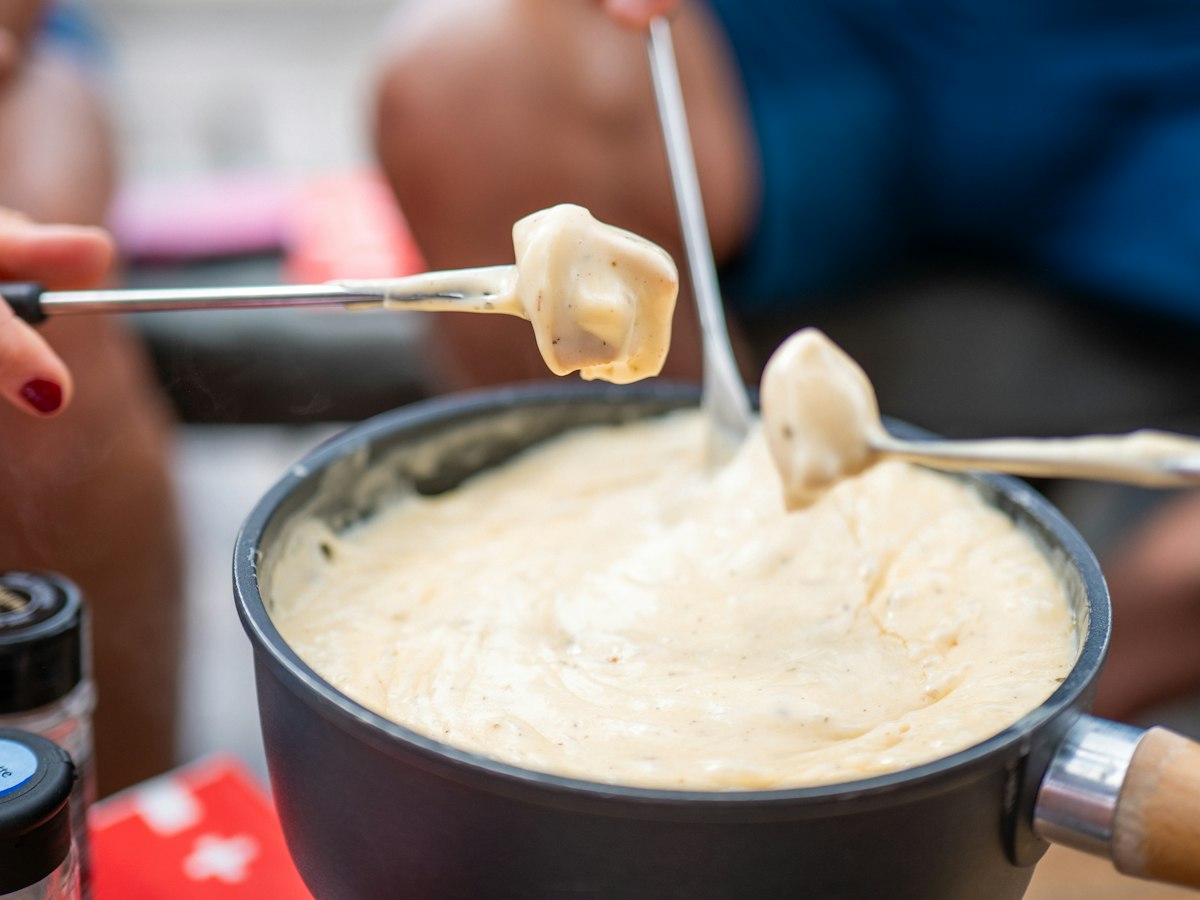
There is a fondue pot in a great many American cupboards, and most of them arrived as presents. In the 1960s the set was a popular wedding and holiday gift. One account from the period has a single couple receiving four.
The pots outlasted the fashion, and the food deserves better than its reputation. Done properly, fondue is three good dishes and a reason to keep people at the table for two hours. These are the three that made the craze, with proportions that work.
How it got here
Fondue was sold to the world on purpose. The Swiss Cheese Union, a cartel formed in 1914, promoted it as the national dish from the 1930s. It was shown at the New York World's Fair in 1939 and again at the Swiss Pavilion's restaurant at the fair of 1964.
The other two versions reached America through one New York restaurant, the Chalet Suisse. Konrad Egli of the Chalet Suisse is credited with introducing fondue bourguignonne, beef cooked in hot oil, to the city in 1956. A Swiss food magazine traces the dish itself to a café in Lausanne in 1948. Chocolate fondue was created at the Chalet Suisse in the mid-1960s as a promotion for Toblerone; accounts of the exact year run from 1964 to 1966.
By 1967 the idea had reached the hostess books. Betty Crocker's Hostess Cookbook, published that year, includes a menu for a fondue party.
The pot matters
The best-looking pots of the period are worth having. Jens Quistgaard's Kobenstyle line for Dansk, in enameled steel, was launched in 1956 and included a fondue pot; the Smithsonian holds a Dansk fondue set from the 1960s. Cathrineholm of Norway made one in its Lotus pattern.
Which pot you use depends on what is going in it. Cheese and chocolate want a ceramic or cast iron pot. Hot oil wants metal, enameled or stainless steel, preferably narrowing toward the top. Never heat oil in a ceramic pot.
1. Cheese
Serves four. The proportions follow the published recipes of Saveur and The Kitchn.
You need: 8 ounces of Gruyère and 8 ounces of Emmentaler, grated; 1¼ cups of dry white wine; one clove of garlic; 1 tablespoon of cornstarch; 2 tablespoons of kirsch; 1 teaspoon of lemon juice; nutmeg and pepper.
Method: Cut the garlic and rub it around the inside of the pot. Add the wine and lemon juice and warm them on the stove until the wine just begins to simmer. Add the cheese a handful at a time, stirring in a figure eight and letting each handful melt before the next. Stir the cornstarch into the kirsch, add it, and keep stirring until the fondue is smooth. Season with nutmeg and pepper and move the pot to its burner, turned low.
If it goes wrong: Too thick, stir in a little more warm wine, up to a quarter of a cup. If it separates, whisk in a splash of wine and lemon juice with a little more cornstarch.
At the table: Cubes of bread, small boiled potatoes, cornichons and pickled onions. The Swiss drink white wine or hot black tea with it, not anything cold. The crust that forms on the bottom of the pot has a name, la religieuse, and it is the best part.
2. Beef in hot oil
Fondue bourguignonne. Serves four.
You need: 1½ pounds of beef tenderloin or sirloin, cut into one-inch cubes and blotted completely dry; peanut or vegetable oil; and three or four sauces. The classics are aïoli, béarnaise, horseradish cream and mustard.
Method: Fill the pot no more than one-third full of oil. Heat it on the stove to between 350 and 375 degrees Fahrenheit, and never let it smoke. Carry it carefully to the table and set it on the burner. Each guest spears a cube and cooks it in the oil. The pot maker West Bend gives 30 seconds for rare and a minute for well done.
Two cautions. The first is about the meat. The Agriculture Department's rule is that cooked food never goes back onto a plate that held raw meat, so give everyone two plates. Its recommended temperature for beef is 145 degrees, and a cube cooked for thirty seconds will not reach it; cook longer if that matters to you or your guests.
The second is about the oil. Do not leave a pot of hot oil unattended, do not refill a burner while it is hot, and put the flame out with its snuffer, not your breath. If the oil ever catches fire, cover the pot with its lid. Never use water.
3. Chocolate
The Chalet Suisse version. Serves four.
You need: 6 ounces of Toblerone, broken up; ¾ cup of heavy cream; 2 tablespoons of kirsch, brandy or orange liqueur.
Method: Warm the cream gently in the pot, add the chocolate and stir until it is smooth and glossy. Stir in the spirit last. Keep it warm over a candle. A full burner will scorch it.
At the table: Cubes of plain cake, ladyfingers, orange segments, strawberries and banana. Dry the fruit first, because water makes melted chocolate seize.
Before you use the old pot
A vintage pot is part of the pleasure, but check it. The Food and Drug Administration warns that antique pottery, and pottery that is damaged, worn or brightly glazed in red, orange or yellow, is more likely to release lead, and that no amount of washing removes it. Home test kits are available. Clemson University's extension service notes that excess cadmium was found in the interiors of some imported enamel cookware in the 1970s.
If the inside of the pot is chipped or worn, or you cannot vouch for it, put it on the shelf where it can be admired and cook in a new one. Use the burner fuel the maker specifies. Then invite three friends, and do not let anyone leave before the chocolate.