
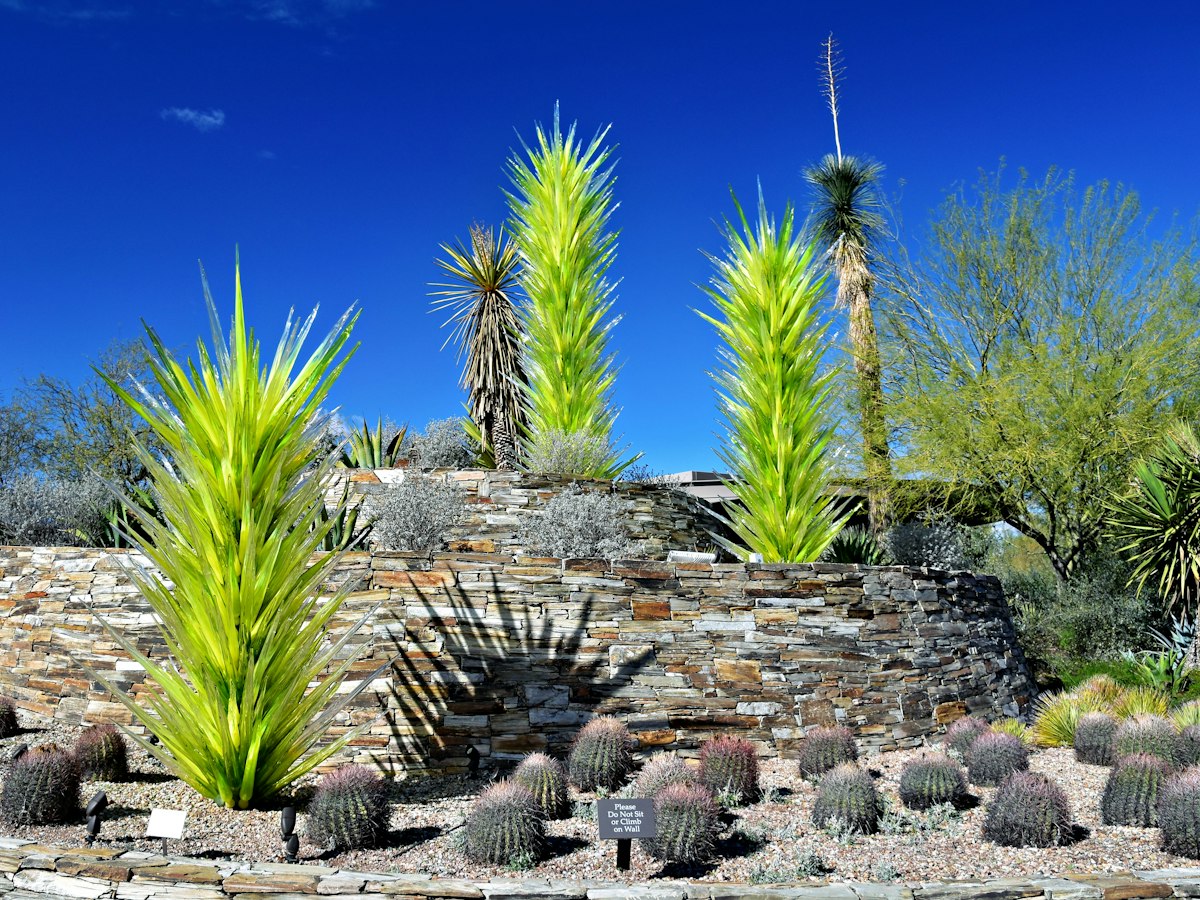
The desert modern garden looks simple because there is so little in it. A few agaves set in gravel. A row of golden barrel cactus along a walk. One olive tree with a silver crown, and a palo verde throwing thin shade on a block wall. Each plant is a shape, placed where you can see all of it, and the ground between them is left alone.
It is worth saying at the start that this is not quite how most of these houses looked when they were new. Look at period photographs of desert tract houses and you will often see turf running to the curb. Water was cheap, and a green lawn was proof you had arrived. The spare planting we now think of as desert modern was there too, in the best gardens of the period, but much of what you see on a house tour today is a later correction. It happens to be a correction that suits the architecture better than the lawn ever did.
The people who made the case first
In Palm Springs the argument for desert plants was being made long before anyone called it sustainable. Chester Moorten, known as Cactus Slim, and his wife, Patricia, opened a nursery in 1939 and turned it into a public garden in 1955. Chester had been a silent film actor. Patricia had trained as a botanist at the University of Southern California. They collected across the Southwest, Baja California and mainland Mexico, and they rescued cactus from land that was about to be built on.
Patricia Moorten also wrote a book with a title that doubles as an instruction: Desert Plants for Desert Gardens. Palm Springs Life credits the couple with treating cactus as something close to an art form and with promoting native planting decades before it became the norm. Their garden still fills about an acre on South Palm Canyon Drive, with roughly 3,000 varieties arranged by the deserts they come from.
The trees
Olive. No tree looks more at home against a white block wall. The leaves are gray-green on top and silver underneath, the trunk twists with age, and the canopy is open enough to see sky through. The catch is pollen and fruit. Ordinary olives are heavy pollen producers and drop fruit that stains paving, and several desert communities have acted on it. Pima County, Arizona, prohibits the sale and planting of olive trees under its pollen control code. Clark County, Nevada, does not permit fruiting olives.
The answer is a fruitless variety. 'Swan Hill', which its growers say was identified by a University of California, Davis, researcher near the town of Swan Hill in Victoria, Australia, makes little or no fruit and very little airborne pollen. 'Wilsonii' is another. Expect a tree about 25 feet tall and as wide, usually with several trunks, that needs regular water while it is young and very little once it is established. Rules differ from one county to the next, so check yours before you buy.
Palo verde. For fast shade, plant 'Desert Museum'. It is a hybrid of three palo verde species that Mark Dimmitt of the Arizona-Sonora Desert Museum began evaluating in the late 1970s; by 1981 he had picked out one thornless seedling as clearly better than the rest. It grows quickly to 20 or 30 feet, keeps a smooth green trunk, and covers itself in yellow flowers from mid-March into early summer. Thin it, never shear it, and do not take off more than about a third of the canopy in summer, or the bark will sunburn.
Palm. The tall, skinny palm of the postcards is the Mexican fan palm. The stouter California fan palm is the one that is native here, growing wild in the canyon oases around the Coachella Valley. Either one works as a vertical line against a low roof. Plant them in a group of odd number, at different heights, and well away from the house.
The sculpture
Agave. This is the plant that defines the style: a rosette that looks drawn with a compass. The big blue century plant, Agave americana, is the classic, and it is also the one to think twice about. It grows wider than most people expect, it sends up offsets for years, and its leaf tips are at eye level for a child. It also flowers once, after a decade or more, and then dies.
The bigger problem is the agave snout weevil. According to University of California pest advisers, the adult bores into the base of the plant to lay eggs, the larvae tunnel through it, and the feeding and the rot that follows usually kill the plant. Often the first sign is a full-grown agave that suddenly collapses. The weevil prefers species with large leaves, and a mature Agave americana is a favorite. If you lose one, remove the plant and the soil around it. The advisers' longer-term advice is to plant narrow-leafed species instead.
That still leaves plenty to choose from. Compact agaves such as Agave parryi and the hybrid 'Blue Glow' stay small enough for a courtyard and give the same geometry at a third of the size. Whatever you choose, give each one room to reach its full width without touching a path.
Golden barrel. The yellow-spined globe that lines so many Palm Springs driveways comes from a small area of east-central Mexico, in the states of Querétaro and Hidalgo. It is endangered there. Wild populations were hit hard in the 1990s by poaching and by the reservoir behind the Zimapán Dam. In gardens it is everywhere, because nurseries raise it from seed, and that is the only kind to buy. It grows slowly into a ball that can pass two feet across. Planted in a grid or a loose drift, it is the nearest thing this style has to a flower bed.
Ocotillo. A spray of thorny canes that leafs out after rain and tips itself with red flowers in spring. Nothing else gives the same height with so little bulk. Buy nursery-grown plants or ones with legal harvest tags; desert states regulate the taking of wild ones.
The ground
What goes between the plants matters as much as the plants. Gravel or decomposed granite in one color, a few large boulders set partly into the soil, and nothing else. The gravel does real work: it shades the soil, slows evaporation and keeps weeds down. It also gives the eye a plain field, which is why three agaves in gravel read as a composition and three agaves in a mixed border read as clutter.
What to leave out
The lawn. In the low desert a lawn is the thirstiest thing on the lot, and the water agencies will now pay to see it go. At the time of writing, the City of Palm Springs lists a turf conversion rebate of $3 a square foot: $2 from the Desert Water Agency and $1 from the city, with no limit on the size of the project, paid first come, first served while the money lasts.
The law is moving the same way. California's Assembly Bill 1572 bans the use of drinking water on purely decorative grass at commercial and institutional properties, with compliance required by January 1, 2027, and it covers the common areas of homeowners' associations as well. It does not apply to a single-family yard. The grass at your own house remains your choice.
Leave out, too, anything that needs shearing into a ball, and anything planted only to fill a gap. The gaps are the design.
How to plant it
Use fewer kinds of plants than you think you need, and repeat them. Five species used well will look more like 1960 than twenty used once each.
Space for the mature size. A desert garden that looks finished on the day it is planted is overplanted, and in five years it will need thinning.
Group plants by how much water they want and put each group on its own drip line. The olive and the agave should not be on the same schedule.
Keep spines away from paths, gates and the edge of the pool. Then light a few plants from below. An agave at night, lit from the ground, is most of the reason people fall for this style.
Proof that it works at scale
If you doubt that so few plants can carry a large space, visit Sunnylands Center & Gardens in Rancho Mirage. The Office of James Burnett laid out nine acres there with roughly 53,000 plants drawn from about 70 native and arid-adapted species, massed in bands of a single kind. The firm says the idea came from the Annenbergs' love of Impressionist painting. Up close it is a lesson in repetition: hundreds of barrels, then hundreds of agaves, then a line of palo verde.
If you go
Moorten Botanical Garden is at 1701 South Palm Canyon Drive in Palm Springs. Sunnylands Center & Gardens is in Rancho Mirage. Both are best in the morning, before the heat, and both will send you home wanting to take out something green and flat.