

Drive east on Ramon Road, past the strip malls, and a building rises out of the flat desert ground like a wave that has decided not to break. Its walls curve inward. Its spire points straight up. It does not look like anything else in Palm Springs, which is saying something in a town that treats architecture as a spectator sport.
This is St. Theresa Catholic Church, and it is the best-known of a small, remarkable group of buildings: the modernist houses of worship of the Coachella Valley. They were put up between 1950 and the mid-1970s by congregations that were often young, rarely rich, and in a hurry to have a proper home in a resort town that was growing faster than anyone had planned for. Almost all of them are still in use. One of them has just traded its pews for a stage.
Here are eight worth knowing.
1. St. Theresa Catholic Church · William F. Cody, 1968
William Cody is best remembered for country clubs and for houses built around golf fairways and cocktails. St. Theresa is the exception, and by most accounts the building he cared about most. Cody was a devout Catholic and, once it was finished, a parishioner. He designed not just the shell but the fittings: the pews with their gently winged ends, the baptismal font, the details down to the trim.
The walls are sprayed gunite, curved in concave sweeps, and the roof is held up inside by a structure of glue-laminated timber posts and beams that reads from the pews like a tent canopy lifted by the wind. Oval clerestory windows let light in high up; an opening above the font drops a shaft of sun onto it. The historian Peter Moruzzi, speaking to Palm Springs Life, said Cody "wanted people enveloped by profound religious calm."

Cody died in 1978 and is memorialized in the church. It remains in remarkably original condition. In 2016 the parish finished a rehabilitation of the exterior concrete and wood trim, helped along by a $5,000 grant from the Palm Springs Preservation Foundation, which keeps a close eye on the building.
2. Temple Isaiah · E. Stewart Williams, 1950, with Wexler & Harrison
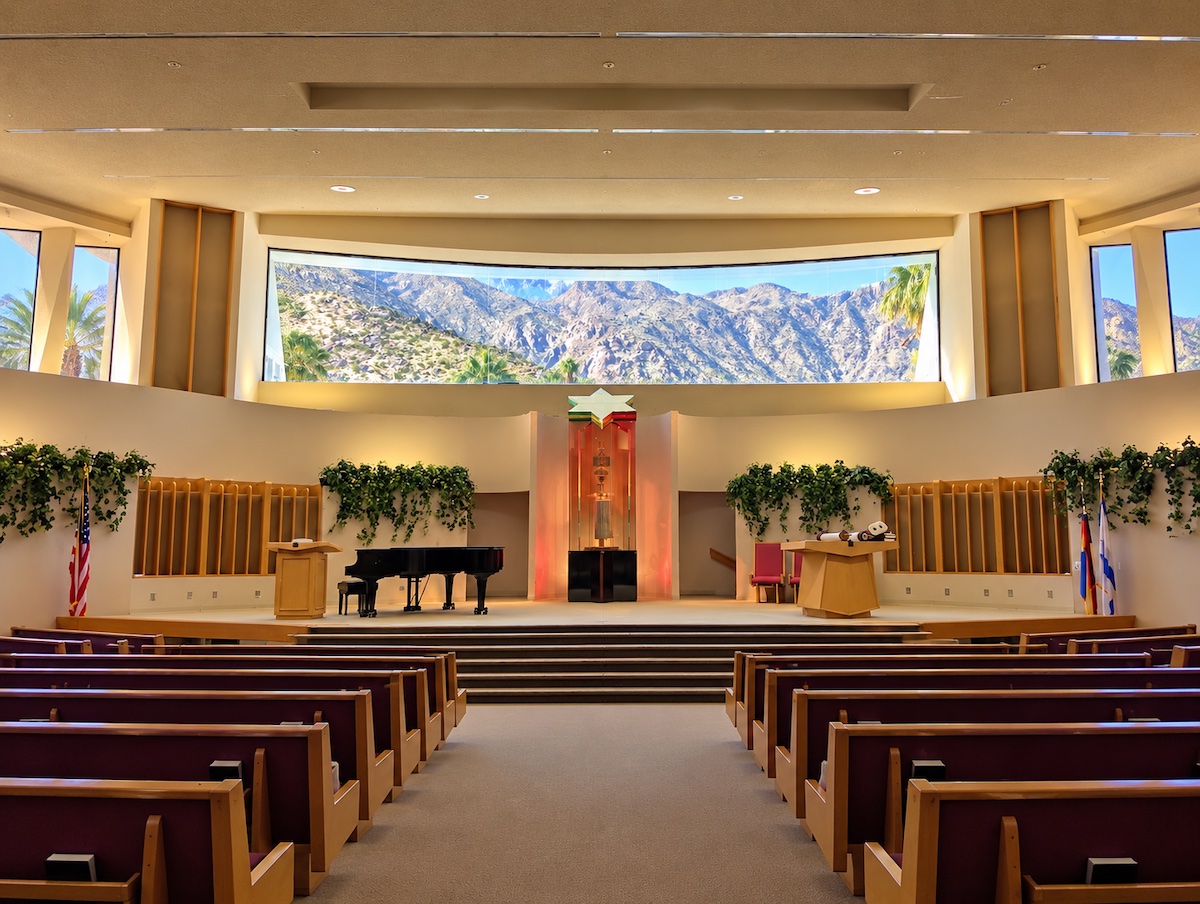
If there is a Donald Wexler thread in this story, it runs through Temple Isaiah on West Alejo Road. The original sanctuary, from 1950, is by E. Stewart Williams, the architect of Frank Sinatra's Twin Palms house. In the early 1960s the congregation hired Wexler and his partner Richard Harrison, the same team behind the steel houses, to expand it.
In the 1980s David Christian wrapped much of the complex in a larger Late Modern enclosure, paid for in part by two fundraising concerts organized by Sinatra himself. Inside are a kinetic Torah ark by the artist Yaacov Agam and stained glass by Eric Ray. In July 2026 the Palm Springs City Council voted 5–0 to make the temple a Class 1 historic site, the city's highest level of protection.
3. First Church of Christ, Scientist · Albert Frey, 1957
This is the one that changed hands. Albert Frey's church at 605 South Riverside Drive held its first service on March 17, 1957. It is pure Frey: walls of sandblasted, terracotta-colored concrete block laid in a stack bond, deep roof overhangs on slender steel posts, floor-to-ceiling aluminum-framed glass, a shed roof over the auditorium and a flat one over the foyer. It was added to the National Register of Historic Places in 2016.
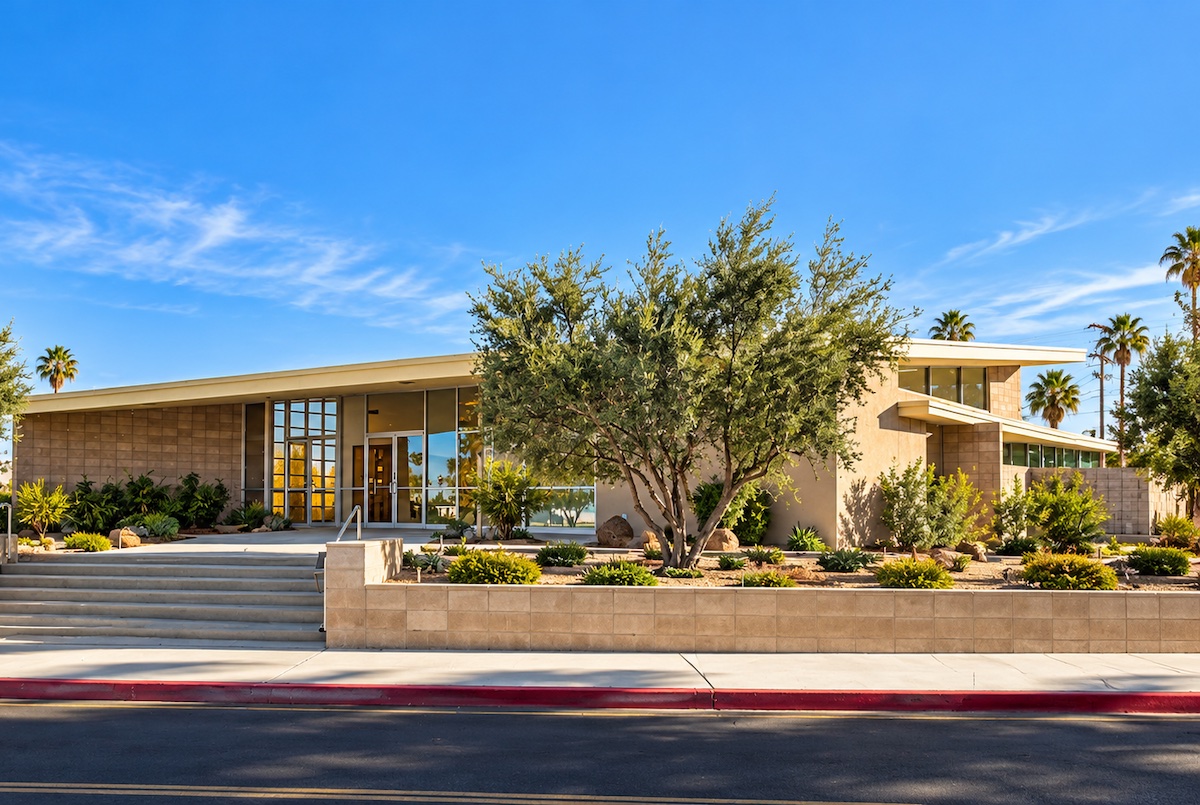
When the Christian Science congregation wound down, the building went up for sale, and in December 2024 it was bought by Dezart Performs, Palm Springs' Equity theater company. Dezart turned the sanctuary into the Dezart Playhouse, a 150-seat theater with dressing rooms, a rehearsal hall and a lobby bar, and staged its first show there in November 2025. In spring 2026 the city raised the building from Class 3 to Class 1 historic status. One member of the preservation board said the building "couldn't find a better steward."
4. First Baptist Church · Howard Lapham, 1963–64
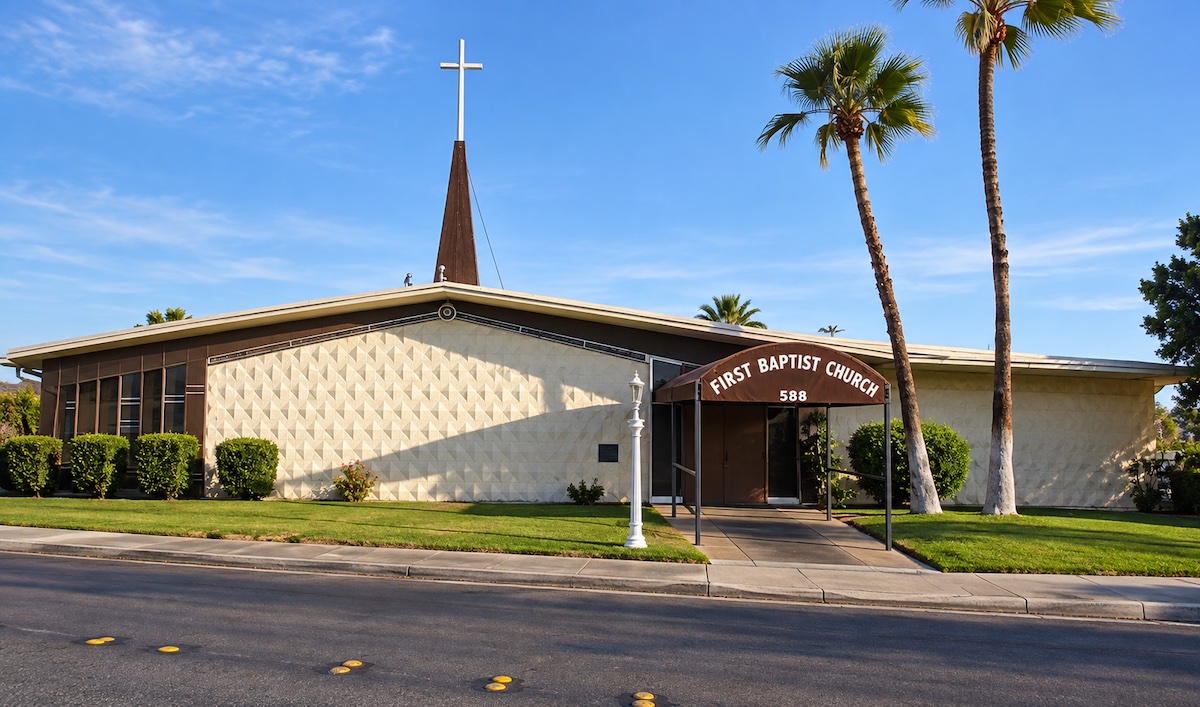
First Baptist's congregation was founded in 1946 on Agua Caliente reservation land, and for its first two years it met in a tent. It was a historically Black church serving families from Section 14, the largely Black neighborhood that was cleared in the 1960s to make way for development. A permanent church was built in 1947.
The modern building on what is now Rosa Parks Road broke ground on September 1, 1963, and held its first service on July 5, 1964. The architect was Howard Lapham; the congregation helped build it, with donated materials. The result is a textured concrete building with a large geometric stained-glass window and a terrazzo floor inlaid with script. It is still the congregation's home.
5. United Methodist Church of Palm Springs · Hal Whittemore, 1965
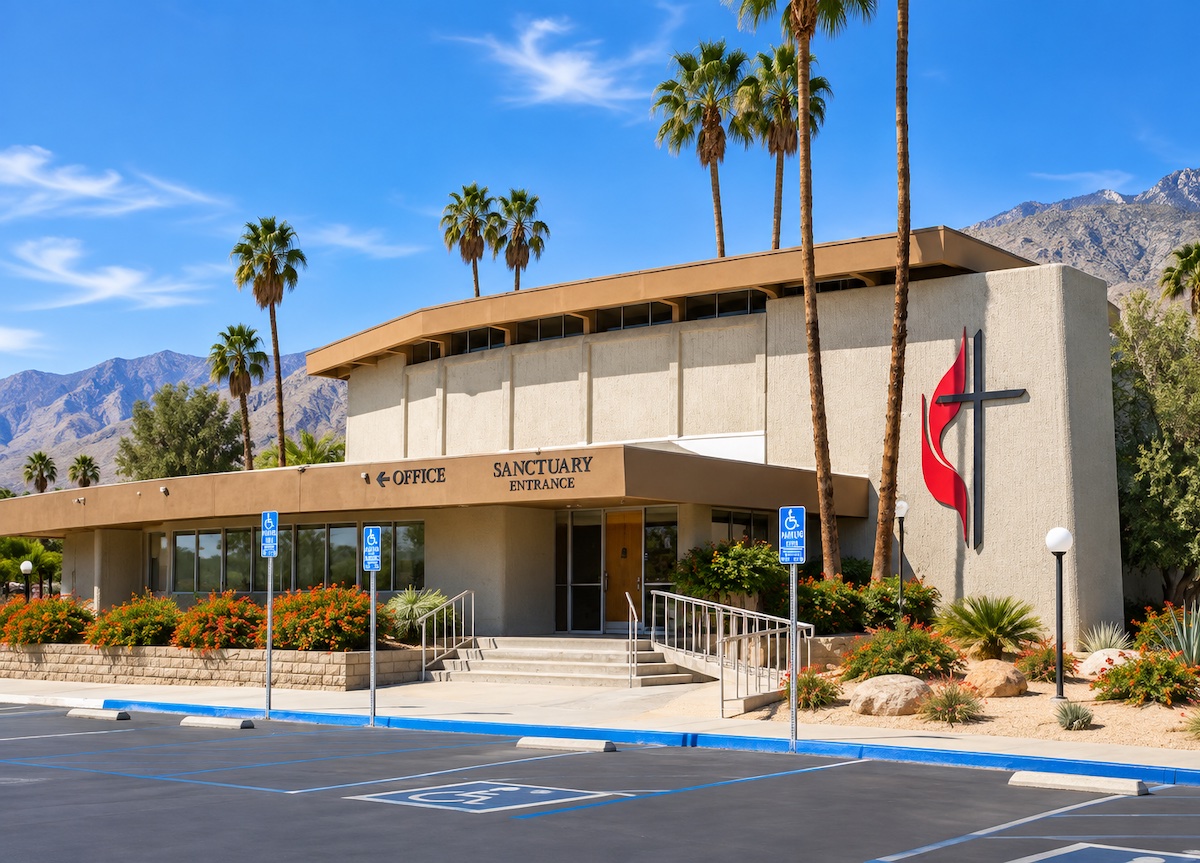
Hal Whittemore's church on East Alejo Road is built of poured concrete in thick, curving sections that look as though they were shaped by hand. A cast-metal cross by the artist J.B. Thompson stands in a reflecting pool, and a big window frames the San Jacinto Mountains. Visitors on architecture tours tend to ask about one pew in particular: a plaque marks the seat where Elvis Presley sat.
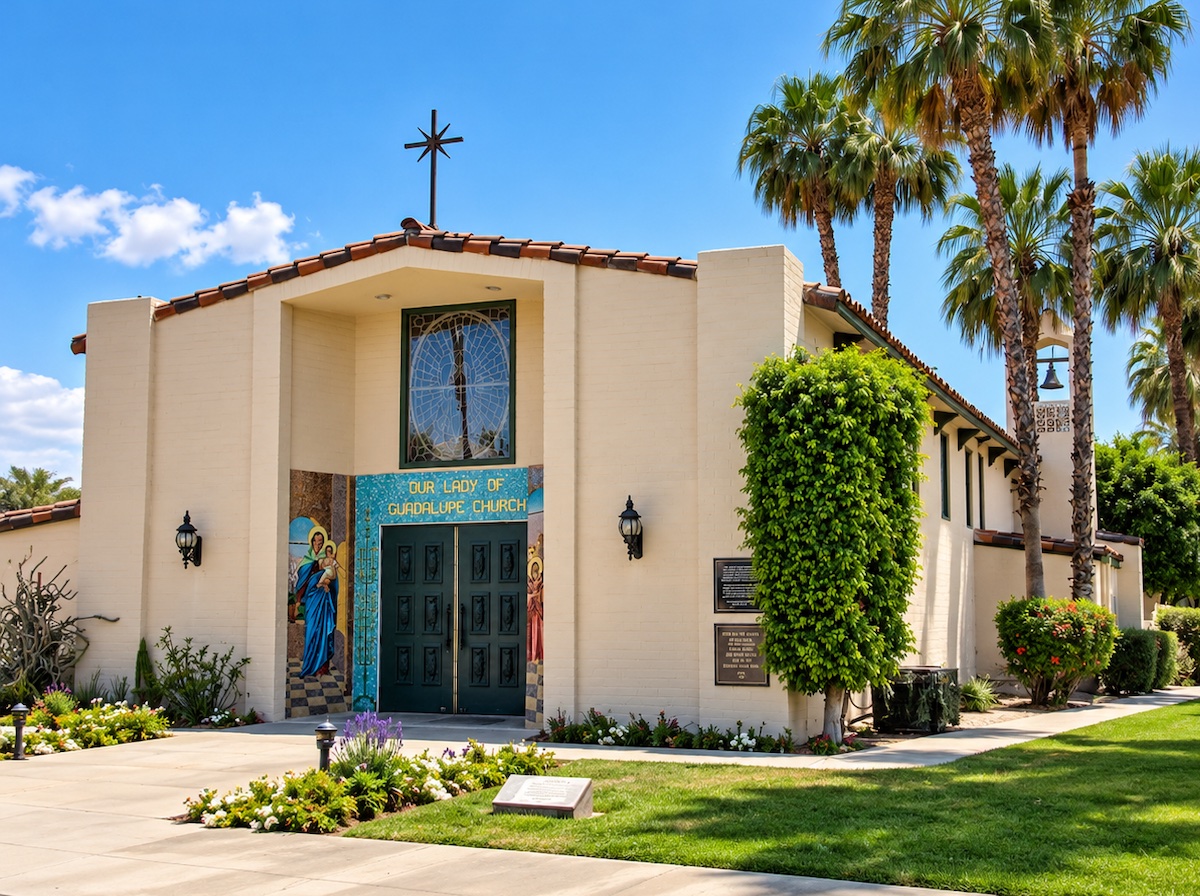
6. Our Lady of Guadalupe Catholic Church · 1963
No one has yet firmly attributed Our Lady of Guadalupe to an architect, which is a shame, because it is one of the most cheerful buildings on this list. A long, low gable runs the length of the church; the interior has terrazzo floors and brightly colored mosaics. The bell tower is wrapped in a concrete-block brise soleil, the perforated sunscreen that became the signature of desert modernism.
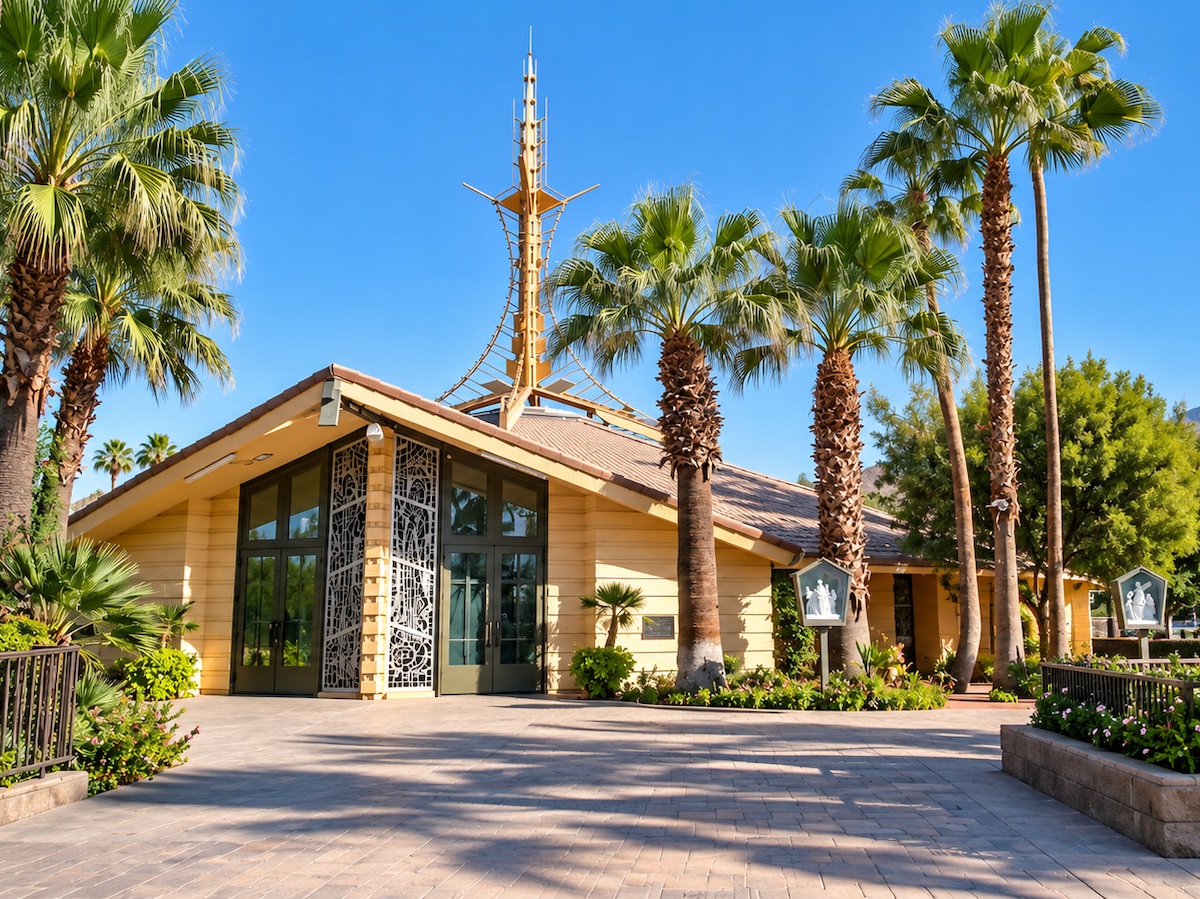
7. St. Louis Catholic Church, Cathedral City · 1973–74
St. Louis parish began in 1948 in half of a former military hospital ward. Its current church, attributed to the architect Joseph F. Dameron, was begun in May 1973 and dedicated on March 3, 1974. The seating wraps around the altar in a semicircle so that no one is far from it. The fifteen stained-glass windows, depicting the Mysteries of the Rosary, were designed and made by Gabriel Loire in his studio in Chartres, France. The parish says the steeple was designed to recall the Eiffel Tower.
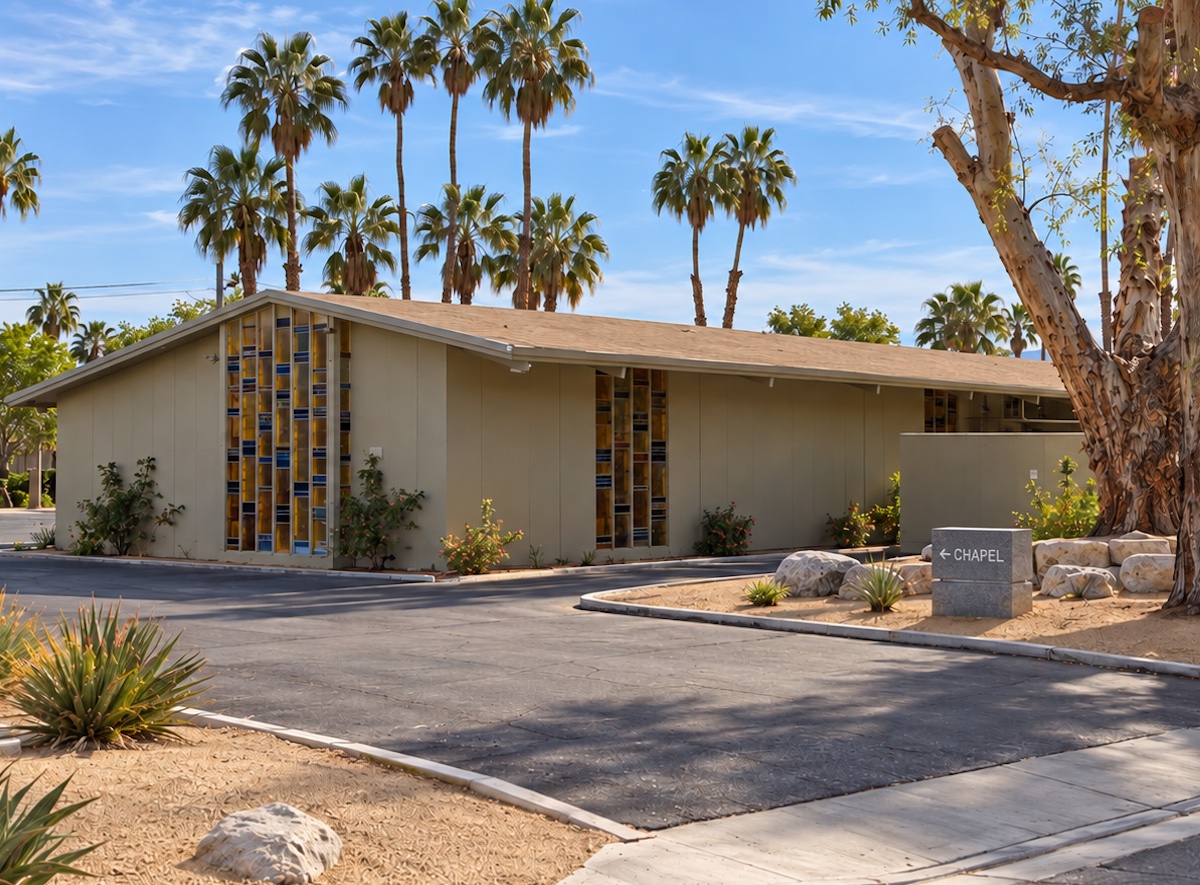
8. The Frey chapel on the funeral-home tour · 1963
The quietest building here is the one most people have never been inside. Modernism Week's "Sacred Places" tours have included a 1963 chapel attributed to Albert Frey that is now part of a Wiefels funeral home. Tour-goers describe intricate concrete-block walls, carved wood panels, geometric stained glass, egg-shaped chandeliers and an original telephone system still in place. Because it is a working mortuary, it is usually seen only on those tours, and the documentation on it is thinner than for Frey's other buildings.
What they have in common
Few of these buildings are large, and several were built on tight budgets: First Baptist's 1963 building was valued at about $100,000. What they share is conviction. Their architects were the same people designing banks, gas stations and weekend houses down the road, and they brought the same materials to God: concrete block, poured concrete, plate glass, laminated timber and aluminum. The desert sun did the rest. Many of these sanctuaries are organized around light, from the clerestories of St. Theresa to the glowing French glass at St. Louis.
Sixty-odd years on, they are aging well. At least two now carry the city's top historic designation, and Frey's Christian Science church is on the National Register. The first to leave religious use found a second life as a theater, which is about as good an outcome as a redundant sanctuary can hope for.
If you go
These are active congregations, a working theater and a working funeral home, so treat them that way. Most churches welcome respectful visitors before or after services; call ahead if you want to see an interior. The easiest way inside several at once is Modernism Week in February, when tours of the valley's sacred spaces are often on the schedule. The Dezart Playhouse can be seen the simple way, by buying a ticket to a show.