
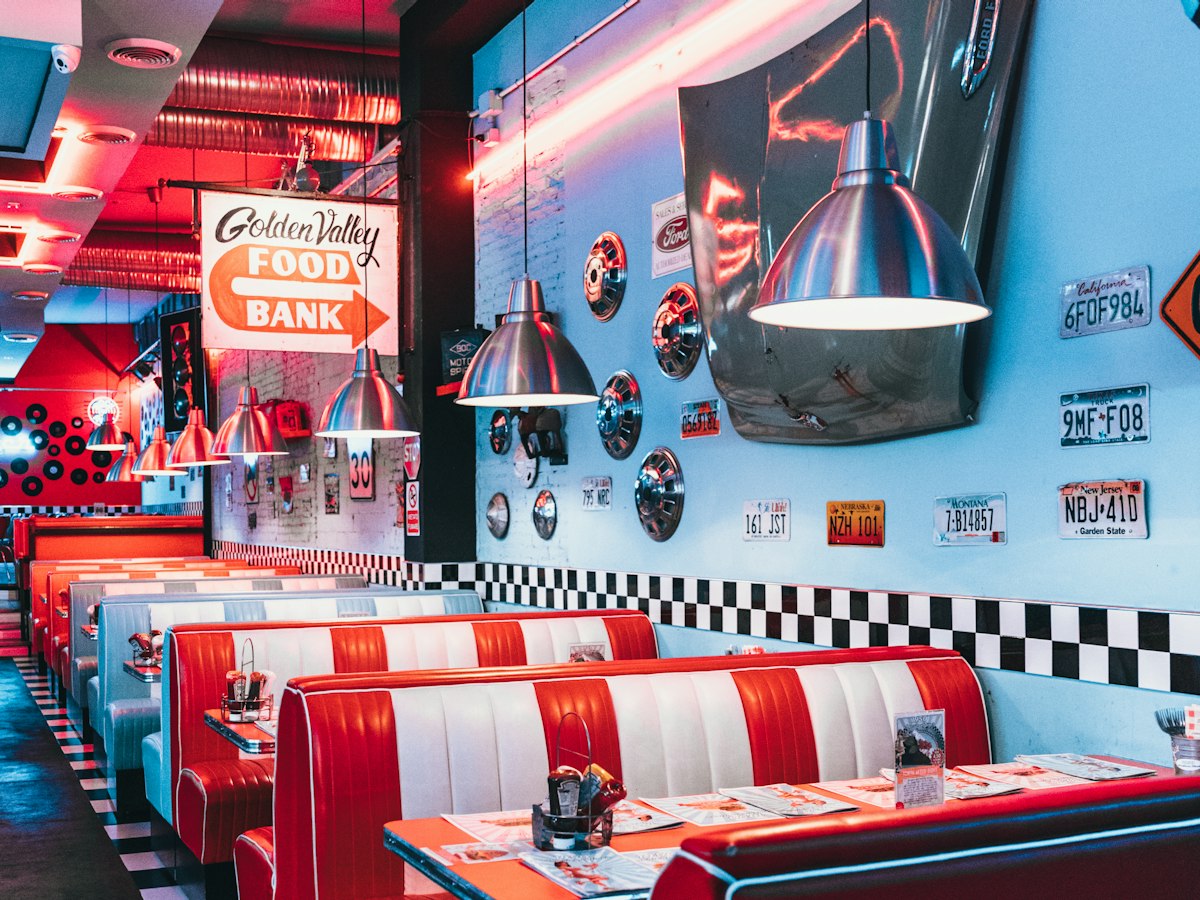
A restaurant is the hardest kind of mid-century building to keep. A house needs one owner who cares. A restaurant needs a landlord, a lease, someone willing to take over and enough customers on a Tuesday, all at once, for sixty or seventy years.
These eight have managed it. Each opened between 1943 and the early 1960s, and each was open at last report. They are not untouched, and we have said what we could confirm is original and what is not. One of them may not be there next year, so that is the one to visit first.
The coffee shops
Pann's, Los Angeles (1958). If you see only one, see this. George and Rena Poulos opened Pann's on La Tijera Boulevard in 1958, in a building by Armet & Davis, the firm behind many of the city's Googie coffee shops, with the designer Helen Fong. The Los Angeles Conservancy lists what survives: the neon sign, the angled roof, the terrazzo floors, the plate glass and the flagstone walls. The Poulos family still owns it, and in 1993 Jim Poulos restored it to its 1958 condition, which won the Conservancy's preservation award. It keeps daytime hours.
Norms, La Cienega Boulevard, Los Angeles (1957). Also by Armet & Davis, and a city Historic-Cultural Monument since 2015. That has not made it safe. The designation protects the building's street fronts, not the business inside. The chicken chain Raising Cane's bought the property in 2021. A hearing on its plans for the building was put off in December 2024 while the two companies talked. The Conservancy reports that the Norms lease expires in December 2026 and that Raising Cane's plans to occupy the building afterward. We found no word of a new lease. Norms was open around the clock at the end of September. Go now.
Bob's Big Boy, Burbank (1949). Wayne McAllister designed it, and it is the oldest Bob's Big Boy still operating. The tall neon sign is built into the structure, and the window walls curve. It was threatened with demolition in the 1990s, and the state named it a Point of Historical Interest. The dining room was updated in 1993, so come for the building and the sign more than the booths.
The steakhouses
Dal Rae, Pico Rivera, California (here since 1958). The Dal Rae began in Los Angeles some years earlier and moved to Washington Boulevard in Pico Rivera in 1958. Los Angeles magazine describes the room: wood paneling, tufted banquettes and a neon sign that says Dining and Cocktails. There is a piano bar. Kevin and Lorin Smith, sons of Ben Smith, one of two brothers who bought the restaurant, run it today.
Golden Steer, Las Vegas (1958, or 1962). The restaurant gives its founding year as 1958. A detailed piece on Casino.org argues that it actually opened in January 1962, citing a newspaper item from that month, and that the earlier date was adopted decades later. Either way it is the old Las Vegas that people come looking for: red leather booths named for celebrities. The room has been altered and enlarged more than once. The Signorelli family has owned it since 2001, and it opened a second restaurant in New York in January 2026.
The supper clubs
The supper club is a Wisconsin institution. Travel Wisconsin, the state tourism office, defines it by what arrives at the table: a relish tray, a brandy old fashioned, steak, fish fry on Friday and prime rib on Saturday, usually in a family-owned place.
The Del-Bar, Wisconsin Dells (1943). Jim and Alice Wimmer founded it, and the third generation of the family owns it now. The Prairie-style building is the work of James Dresser, a protégé of Frank Lloyd Wright. It opens daily at four.
Ishnala, Lake Delton (1953). The Hoffman brothers built Ishnala around a 1909 house in what is now Mirror Lake State Park. The stone fireplace, the log walls and the flagstone floor are original, and pine trees grow up through the roof. It is seasonal: the 2026 season ends on Sunday, October 25.
The HobNob, near Racine (1954). Bill and Belle Higgins opened it on Sheridan Road in 1954. Accounts from recent years describe white booths, fringed drapes, purple ceilings, a 1950s menu under glass and a revolving carousel in the bar. New owners took over in February 2024 and spoke of a minor facelift. We could not confirm how much has changed since, so call before you drive far.
Why some rooms survive
The Los Angeles Conservancy, which keeps a list of what it calls legacy businesses, makes a point that explains this whole list. Landmark status mainly helps the owner of a building. It does little for a tenant. What closes old restaurants is rent, redevelopment and the lack of anyone to take over.
Norms and Pann's are the two halves of that argument. One is a protected building with a lease running out. The other has no city landmark designation that we could find, and is safe because the family that built it still owns it and paid to put it back the way it was.
Before you go
Check that the place is open, and when. Then order what it has always served, and sit in a booth if there is one.