
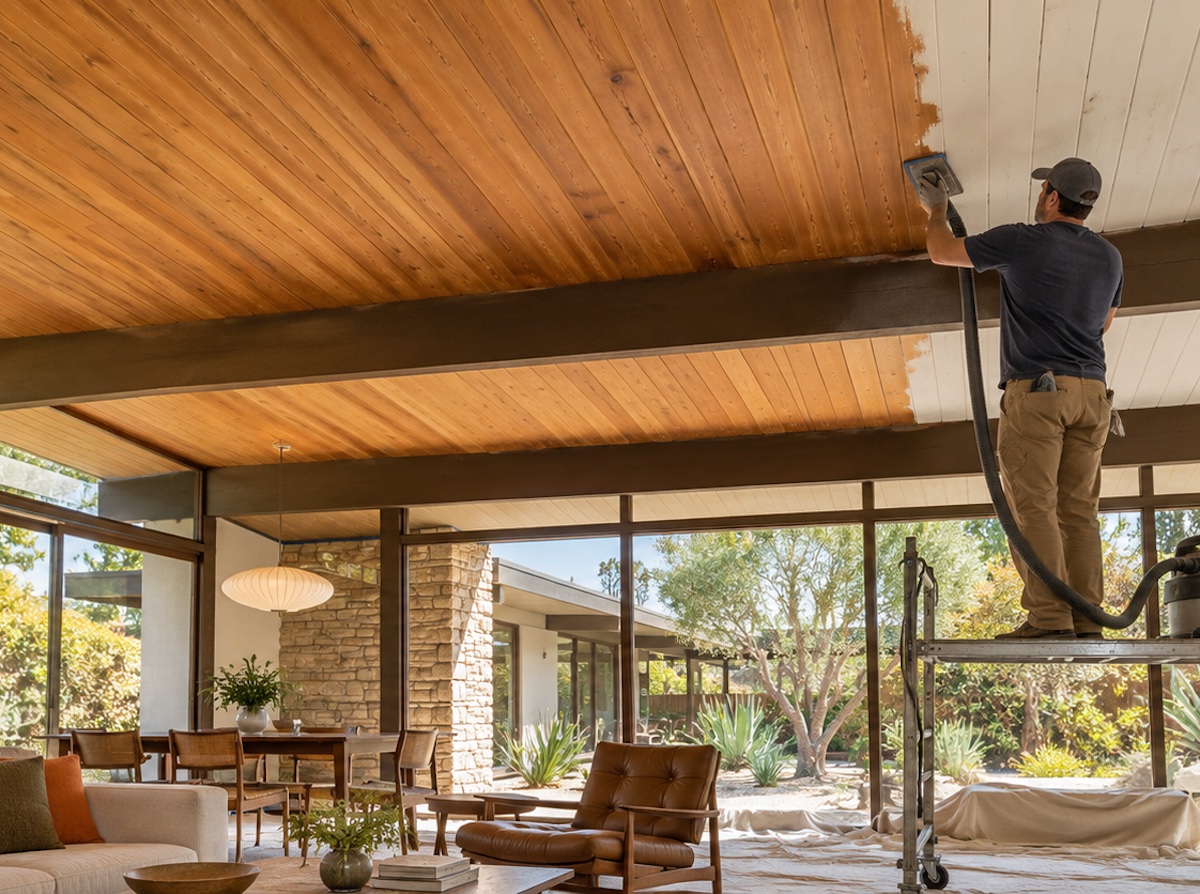
In a post-and-beam house the ceiling is not a ceiling in the usual sense. The boards overhead are thick tongue-and-groove planks that span from beam to beam, and the other side of them is the roof. There is no attic and no drywall. What you see from the sofa is the underside of the structure.
It is also, in a great many houses, painted white. Getting it back to wood changes a room more than any other single job, and it is one of the most unpleasant jobs in restoration. This is what is up there, what it takes to bring it back, and what it is likely to cost.
What you are looking at
The boards are usually two-by-six planks of redwood or Douglas fir, milled with a tongue on one edge and a groove on the other, and often with a small V where two boards meet. In Eichler houses, owners on the Eichler Network forums describe original redwood decking in lengths of 13 feet and more, carried on Douglas fir beams of about four by ten inches.
The original finish is the surprise. It was usually neither clear varnish nor white paint. Eichler owners who have looked under light fixtures and inside closets report the same thing again and again: a thin gray wash, which several identify as Cabot's Dune Gray, a semi-transparent stain brushed on lightly and left streaky so the grain showed through. An Eichler Network article on beams describes the original scheme as a light wash on the ceiling with beams in a contrasting dark or white.
So before you plan anything, find out what your own house had. Unscrew a light fixture canopy, or look at the ceiling of a closet that was never repainted. Whatever is under there is your target.
Decide whether it is worth it
Be honest about this part. The Eichler Network's guide to the work describes stripping with chemical strippers followed by extensive sanding, and calls it messy. One owner who did it called it a labor of love. Another pointed out the plain difficulty of working on a ladder under a high peak.
There is no shortcut that gives the same result. Owners who tried staining over an old finish report that it comes out looking like solid paint. If you want to see grain, the paint has to come off completely.
There are respectable alternatives. One is to repaint in the original arrangement, a light ceiling with dark beams, which restores the contrast even if it does not restore the wood. Another, which one owner describes, is a painted base coat with a semi-solid stain brushed over it to suggest grain. Neither is the real thing, and both cost a fraction of it.
Test for lead before anyone sands
If the house was built before 1978, assume the paint may contain lead until a test says otherwise. Sanding a ceiling puts the dust directly above your face and then all over the room.
Federal rules are specific here. Under the Environmental Protection Agency's renovation rule, any contractor paid to disturb painted surfaces in a pre-1978 home must be certified in lead-safe work practices. Homeowners working on their own houses are generally exempt, but the agency recommends that they follow the same practices. Ask every bidder for the certificate.
Three ways to take the paint off
Chemical stripper. A paste stripper is brushed or troweled on, left to soften the paint, and scraped off. It is slow and it is messy, and it usually takes more than one application. Its great advantage is that it reaches into the V-grooves and lifts the paint without removing wood. Owners on the Eichler forums mention the Peel Away products for this.
Sanding. Sanding is fast on the flat face of a board and nearly useless in the grooves. It also removes wood along with the paint, which rounds the crisp edges of the boards and can cut through the aged surface into fresh wood of a different color. As the only method, it is how grain gets lost. As a light final pass, it is necessary.
Blasting. Sandblasting is quick, and one Eichler owner who tried it reported the problem: the sand ate the soft parts of the grain faster than the hard parts and left ridges that then had to be sanded down. Another warned that the results on latex paint were poor.
Dry ice blasting is the gentler version. Pellets of frozen carbon dioxide hit the surface and turn straight to gas, so they lift a coating by thermal shock with very little abrasion, and they leave no grit behind. Conservators use the method on museum objects. It needs strong ventilation, because the gas displaces air, and it is loud. If a contractor offers it, ask for a test patch on your own ceiling before agreeing to anything.
What the good crews do differently
They test first. A good crew strips a small area in a closet or a corner before it quotes, to see how many coats there are, whether there is lead, and how the wood responds.
They seal the room. Plastic over the floor, the walls and the doorways, the heating system off, and sanders connected to a vacuum. The Eichler Network guide makes the same point about pairing sanders with a shop vacuum.
They strip first and sand last. The chemical does the heavy work. Sanding is light, with the grain, and done by hand in the grooves. They do not run a machine across the joints.
They stop before the wood is gone. A few flecks of paint deep in a groove are better than a board sanded flat. The aim is old wood with its surface intact, not new-looking lumber.
They ask about the roof. Because these boards are the roof deck, a leak above shows up as a stain below, and a roofer's fastener that is too long comes through the ceiling. Restore the ceiling after the roof is sound, not before. Insulation belongs on top of the deck, added when the roof is replaced, so the boards stay visible from inside. A reroofing is also the moment to replace a damaged board, since it can be lifted out from above.
They stain thin. Owners who matched the original finish recommend a water-based semi-transparent stain, brushed on and wiped back with rags in several light coats, and never rolled, because a roller lays down too much. Try it on a scrap or a hidden board first. Sixty-year-old wood has darkened, so an exact match to the sample under the light fixture is unlikely. Close is the realistic goal.
What it costs
There is no published price for exactly this job, so treat what follows as a way to judge a bid, not as a quote.
Angi's 2026 cost data puts professional paint removal from wood at $9 to $12 a square foot. By method, it lists chemical stripping at $2 to $10 and sanding at $4 to $12. A 2026 pricing guide from the blasting contractor One and Done Prep puts dry ice blasting at $6 to $14 a square foot. HomeAdvisor puts staining at $2 to $4 a square foot with labor and materials.
A ceiling sits at the top of those ranges. The work is overhead, the grooves have to be done by hand, and lead containment adds time. For a house with 1,200 square feet of ceiling, removal at $9 to $12 comes to $10,800 to $14,400, and staining adds $2,400 to $4,800. That is roughly $13,000 to $19,000 before any repairs to the boards or the beams.
Get three bids, and ask each bidder the same questions. Which method, and why? Will you do a test patch? Are you lead-safe certified? What do you do in the grooves? The answers will tell you more than the price.
If you do only one thing
Take down one light fixture and look at what is underneath. It costs nothing, and it settles the question that matters most, which is what this ceiling was meant to look like. Everything else is a decision about how close you want to get.