
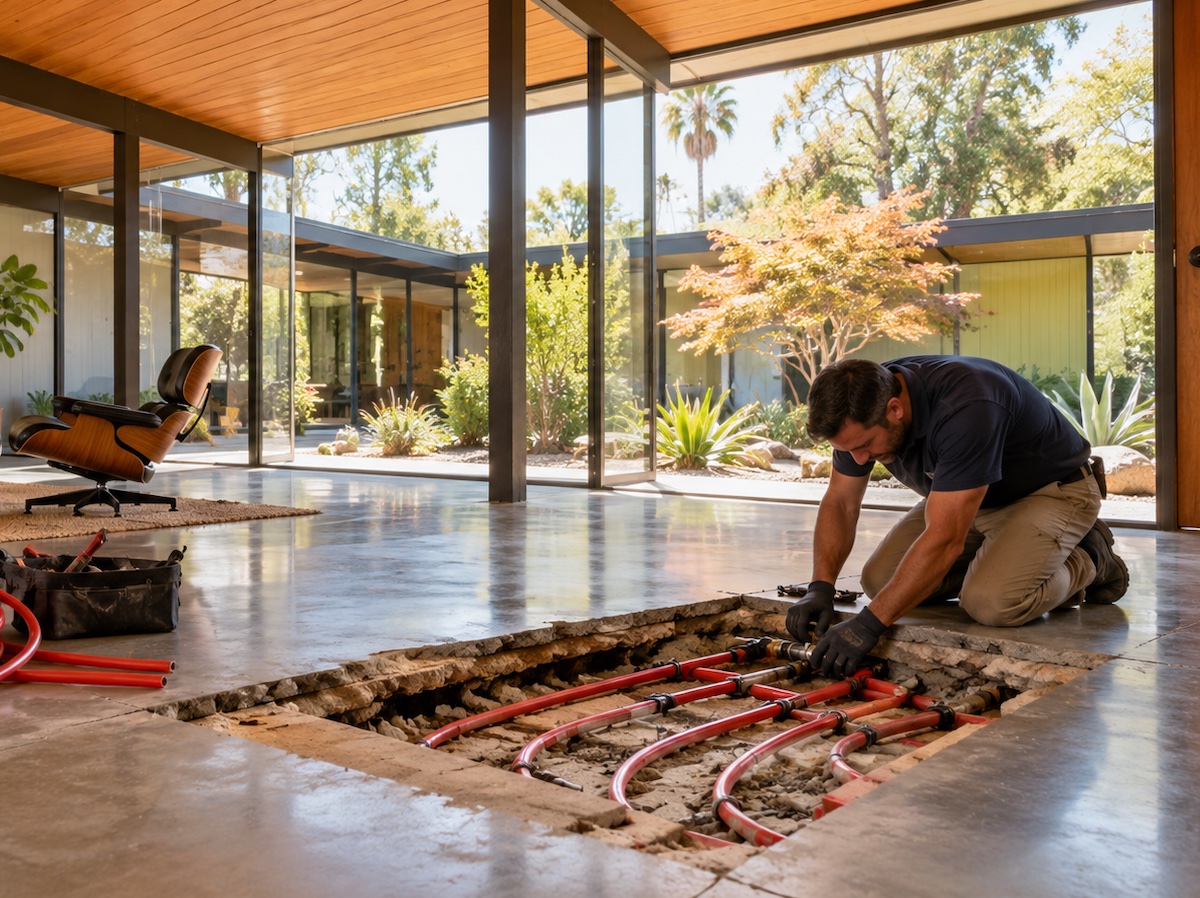
An Eichler has no furnace in a closet and no ducts in an attic, because it has no attic. The heat is in the floor. A boiler warms water and a pump pushes it through loops of pipe cast into the concrete slab, and the whole floor becomes a low, even radiator. People who have lived with it tend not to want anything else.
The pipes are also sixty or seventy years old and buried in concrete. When one leaks, every owner faces the same three choices: repair the system, replace it with new radiant heat, or abandon it and heat the house another way. Here is what each one involves and what the published numbers say it costs.
First, find out what is in the slab
Everything depends on the pipe. Some early 1950s Eichlers were built with steel tubing; later houses got copper. The builder Craig Smollen, who writes about these systems, attributes the early steel to a copper shortage.
The two metals fail differently. Anderson Radiant Heating, a Bay Area firm that specializes in these houses, says plainly that copper systems are repairable and steel systems are not: once steel begins to deteriorate, the damage is general and the only fix is a new system.
There is a nuance worth knowing. Jerry Rothfeld, a retired hydronic heating specialist writing for the Eichler Network, points out that a sealed system does not rust from the inside, because the water gives up its oxygen soon after the first fill. What destroys steel pipe is water arriving from outside, from a roof leak or poor drainage. A dry, well-kept steel system can still be working. A wet one will not be for long.
How you know there is a leak
Smollen lists the signs: a water bill that climbs for no reason, a warm patch of floor, hairline cracks, the sound of running water, or a white mineral crust at the edge of the foundation. A system that needs topping up is leaking somewhere.
That last point matters for another reason. Fresh water carries oxygen, and oxygen is what corrodes pipe. A leak that is fed with new water every week is making the next leak.
Choice one: repair
For a copper system this is usually the right answer. A pressure test confirms that there is a leak. To find it without tearing up the floor, Anderson injects helium into the pipes at low pressure and locates where it escapes with a detector sensitive to one part per billion. The crew opens the slab at that spot with a small jackhammer, brazes the pipe, and tests again, holding pressure for 45 minutes.
The firm says most repairs take a day. Its published figures put a typical Eichler repair at $1,250 to $2,500 and say the bill should never exceed $7,500. Smollen quotes $1,850 to $2,500 for each pinhole. The cost of patching the finished floor is on top of that.
While the plumber is there, look at the boiler. Rothfeld notes that most original boilers are grossly inefficient by modern standards. A current standard boiler runs at about 85 percent efficiency, more than 20 points better than the originals. The sealed high-efficiency models reach the mid-90s, but he cautions that they cost a good deal more to install and save only another six to ten percent on fuel.
Choice two: replace it with new radiant
If the pipe is steel, or copper that keeps springing leaks, the system can be rebuilt with modern plastic tubing. There are two ways to do it.
The first is to cut shallow slots in the existing slab, lay the new tubing in them and resurface. It is loud and dusty work, but it keeps the floor at its original height.
The second is to build on top of the slab, either with tubing set in a new layer of cement or with grooved panels made for the purpose. Rothfeld warns that an overlay raises the floor by an inch and a half or more, which means trimming doors and rethinking thresholds. Panel systems are thinner; Smollen describes one at 13/16 of an inch.
For cost, the most detailed published estimate comes from a real estate site that specializes in Eichlers. It puts new tubing in or over the slab at $15,000 to $30,000 depending on scope, and panel systems at $15 to $30 a square foot installed, before new flooring. Treat these as rough guides, not bids.
Choice three: abandon it
The third choice is to leave the old pipes where they are and heat the house some other way.
Hydronic baseboards. Hot water from a boiler runs through slim radiators along the walls. Rothfeld calls this perhaps the least expensive replacement, and notes the price in wall space. The same real estate site estimates $13,500 to $19,500 for a complete system with a new boiler. It heats and does not cool.
Ductless heat pumps. Wall-mounted units inside connect to a compressor outside. They heat and cool, they need no ducts and no hole in the roof, and each room can be controlled separately. The estimate for a three- or four-zone system is $10,000 to $20,000. Hilary Davis, a Bay Area agent who chose this for her own Eichler after the radiant failed, wrote that she was pleased with it and that she still missed the warm floors. She also noted that rooftop equipment was restricted in her neighborhood, which ruled out ordinary forced air.
Small-duct forced air. A system of narrow flexible ducts that provides heating and cooling, estimated at $15,000 to $25,000. Owners on the Eichler Network forums report that it can require roof work, which changes the arithmetic if the roof is new.
Electric floor mats. These come up often and seldom work out. One engineer on the Eichler forums calculated that the mats put out about half the heat an Eichler loses, and California's energy code restricts electric resistance heat as a primary source.
One thing that helps whatever you choose
If the system still runs, take up the carpet. Rothfeld estimates that wall-to-wall carpet over a pad can cut the output of a radiant floor by half or more. Bare concrete, tile and stone work best. A house that never seems to warm up may have nothing wrong with its pipes.
How to decide
Copper pipe with one or two leaks: repair it. A few thousand dollars buys back the best heat the house will ever have.
Steel pipe that is leaking, or copper that leaks again and again: stop patching. Choose between new radiant and abandonment, and let the floor decide. If you are replacing the flooring anyway and can accept a higher floor or the dust of slot cutting, new radiant keeps the house as it was designed. If the floors are staying, or you want air conditioning, a heat pump is the practical answer.
And if you are buying, ask for a pressure test before you close. The seller's word that the heat works is not the same as a gauge that holds for 45 minutes.