
For about fifteen years after the war, American businesses built as if the customer were arriving at speed, which the customer usually was. Roofs tilted up toward the road. Signs grew taller than the buildings they advertised. Steel pylons went straight through the roof and kept going. The point was to be seen from a moving car and understood in a second.
The style took its name from Googies, a coffee shop that John Lautner designed in 1949 at Sunset Boulevard and Crescent Heights in Hollywood. Three years later the editor Douglas Haskell used the name in House and Home for the whole genre, and he did not mean it as a compliment. By the 1970s the profession had moved on, the buildings were simply old, and they started to come down. Googies itself was demolished in 1989.
What has changed lately is the kind of building being rescued. The early preservation fights in Los Angeles were over coffee shops. The recent ones involve the workaday end of the commercial strip: a car wash, a bowling alley, a bank. Only one of the three is Googie by a strict definition, and none of the stories is finished. Together they show what saving this kind of architecture now takes.
A note on the images: the pictures in this article are AI-enhanced, stylized creative renderings by an AI artist, not documentary photographs. They combine each building's original vintage style with the way it looks today. In real life, sadly, the buildings have become a bit more run-down, or are simply a little less respected than they deserve. Even the restored car wash is missing some of the exciting Googie details that appear in our more fantastic rendering.
The car wash · Whittier, California
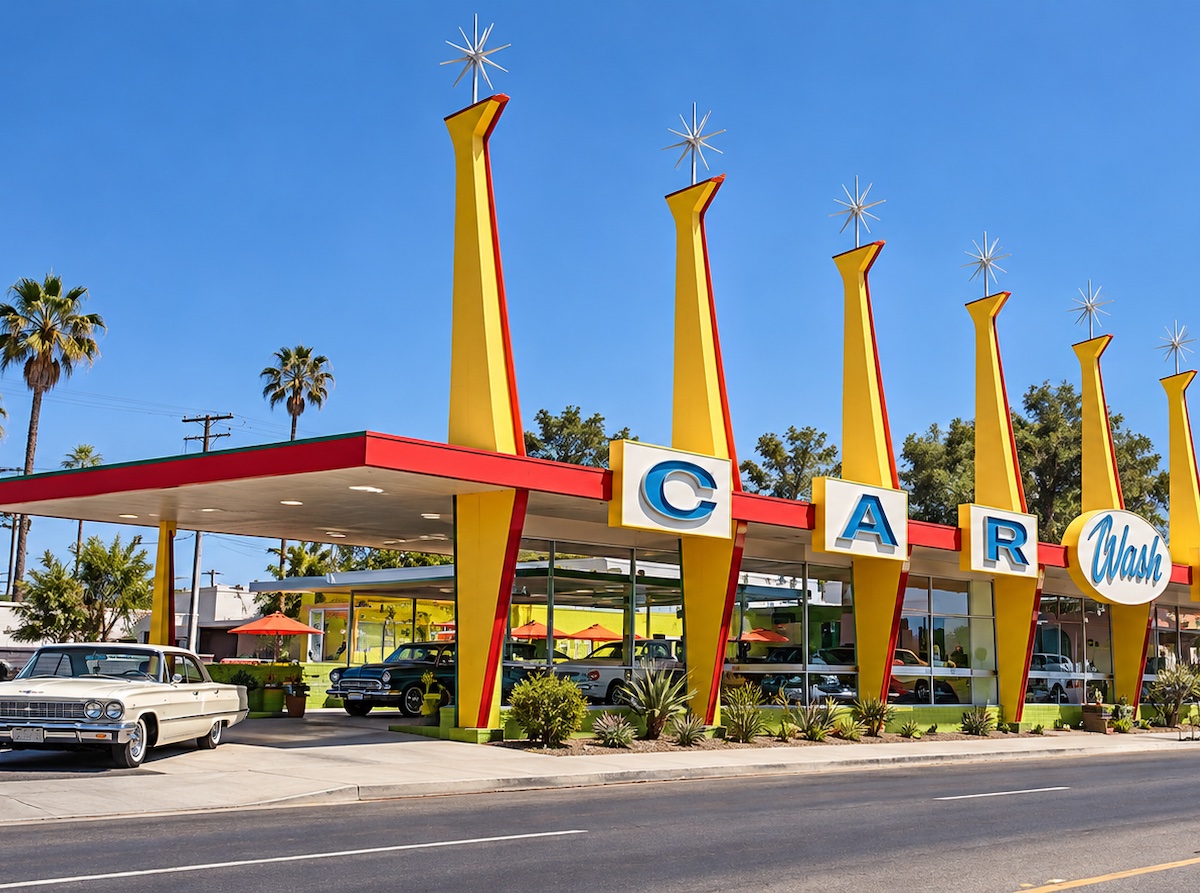
The Five Points Car Wash was built in 1962 for George Urich, an oil man who was an early promoter of the self-service gas station, at an intersection where five streets meet. It is the real thing. A flat roof with a deep overhang sits over a 180-foot wash tunnel, and a row of steel pylons, each about 35 feet tall, punches up through it. A sign pole with two enormous points finishes the composition. The Los Angeles Conservancy rates it among the finest intact Googie car washes in Southern California.
It is also still washing cars. A new owner bought the site in 2017, renamed the business Googie Car Wash, and spent much of 2019 restoring the tunnel, the pylons and the neon before reopening that November. Then, on August 26, 2025, the Whittier City Council voted 4-0, with one member absent, to add the car wash to the city's official register of historic landmarks. A Mills Act agreement followed. That is the California program that trades a lower property tax bill for a commitment to maintain a historic building to preservation standards.
Of the three, this is the closest to a clean win: the original use, the original structure, a legal protection and a financial reason for the owner to keep it up.
The bowling alley · Sacramento, California
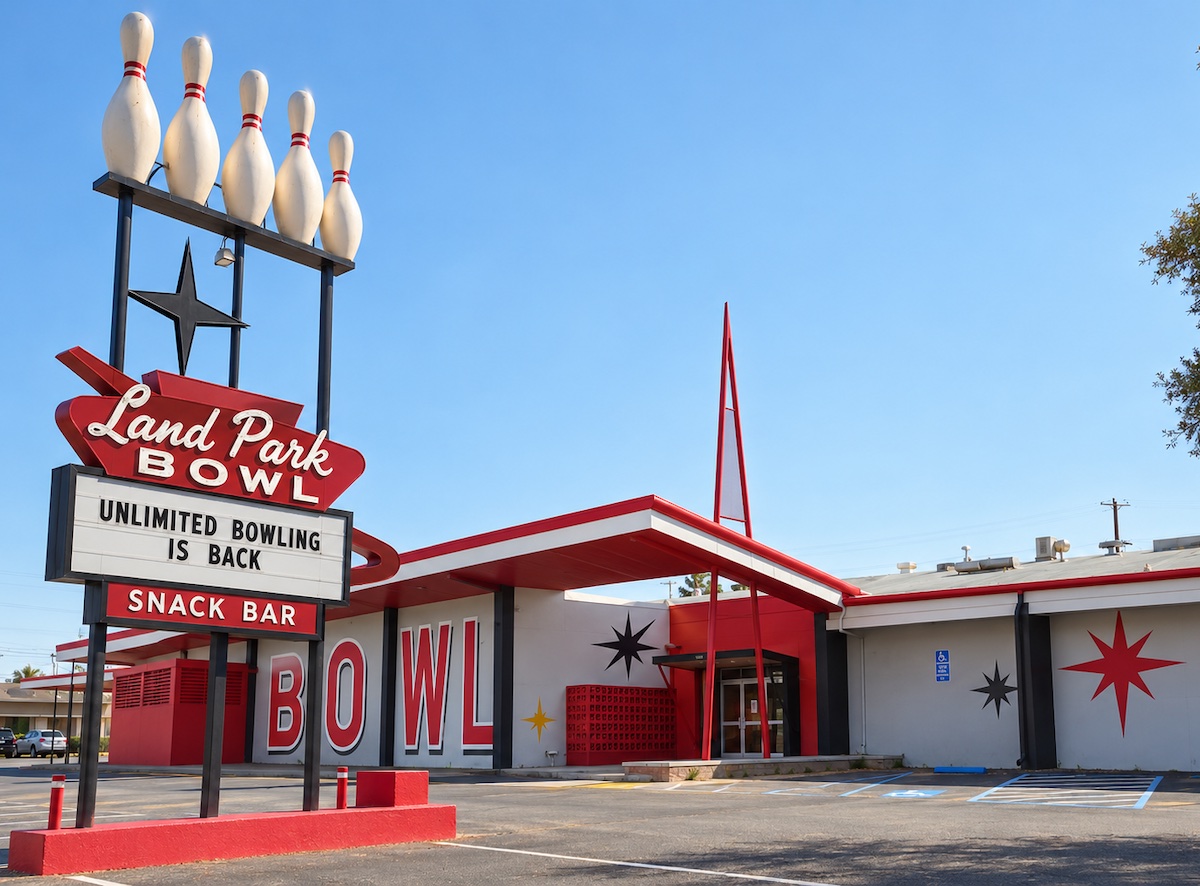
Land Park Bowl opened in 1960 on Freeport Boulevard. Its owners, Gonzo and Toki Sakai, had bought the land two years earlier, and the building they put up had 32 lanes, a cocktail lounge, a restaurant, a nursery and a play area for children. The city describes it as mid-century modern, not Googie, but the family resemblance is plain: a folded-plate roof, a geometric awning over the door and a space-age sculpture at the entrance.
For decades it was home to Japanese American and LGBTQ bowling leagues, and by the end it was the last bowling alley inside the Sacramento city limits. A fire in February 2024 left the interior badly water-damaged, and the corporate owner said the following month that it would not reopen.
On July 22, 2025, the City Council voted unanimously to add the building to the Sacramento Register of Historic and Cultural Resources, citing both the architecture and the communities that had gathered there. In March 2026 the owner, now called Lucky Strike Entertainment, put the property on the market: roughly 28,000 square feet on two and a half acres, for $3.1 million.
So the building is protected, and its future is unknown. Landmark status means the city reviews major changes and can make demolition slow and expensive. It does not bring back the lanes. The listing pitches the site for adaptive reuse, and the nearest precedent is Covina Bowl in Southern California, a 1956 Googie landmark by Powers, Daly and DeRosa that closed in 2017. There the city approved a plan in 2021 that kept part of the original building and its A-frame neon sign and built townhomes around them. It is a compromise, and probably the realistic model.
The bank · Oklahoma City, Oklahoma
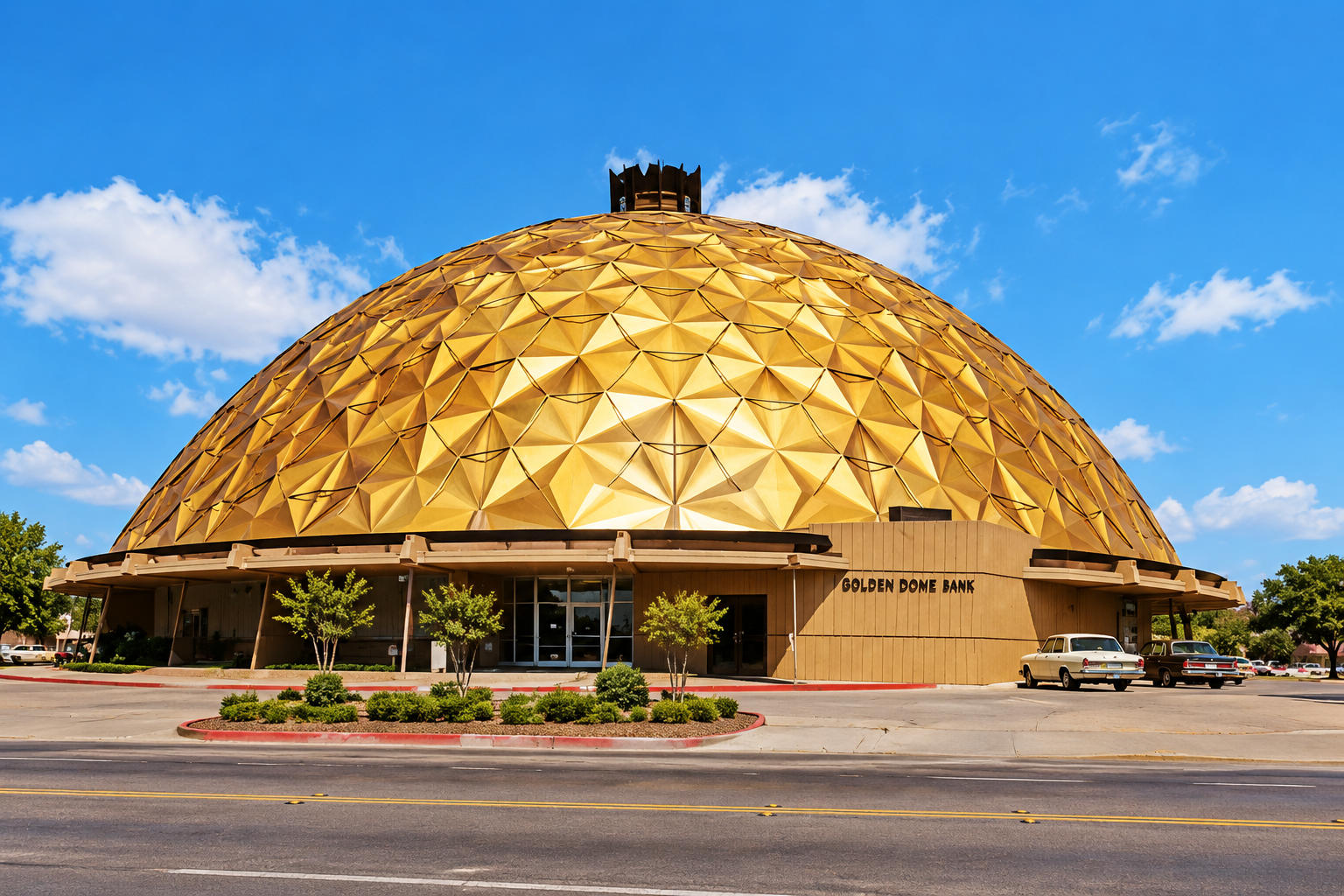
The Gold Dome opened in 1958 as Citizens State Bank, at Northwest 23rd Street and Classen Boulevard. The local firm Bailey, Bozalis, Dickinson and Roloff built it on Buckminster Fuller's geodesic principle: 625 panels spanning 145 feet. It is often described as the first geodesic dome ever used for a bank. A purist would call it space-age modern instead of Googie. To anyone driving past, the distinction is academic.
It has come close to demolition twice. A later bank owner sought to tear it down in 2001 and was stopped by a citizens' campaign; the dome went onto the National Register of Historic Places in 2003. Another owner applied for a demolition permit in 2013, and the city declined to issue it. After that the building sat, spared and largely unused.
The break came on January 28, 2025, when the City Council approved a $10 million plan to turn the dome into a concert venue for about 3,000 people: $3 million in public tax-increment money and $7 million from private investors, with a Tulsa promoter, Kismet Koncerts, as developer and operator. That spring the developer said construction could start in late 2025 or early 2026 and would take about eight months. The financing is the milestone. The opening night is still to come.
The coffee shop that showed how
If these three look more hopeful than they would have a decade ago, one reason is a building that did reach the finish line. Stanley Burke's, a 1958 coffee shop in Sherman Oaks by Armet and Davis with interiors by Helen Liu Fong, spent decades as Corky's before closing in 2020. Los Angeles made it a Historic-Cultural Monument the same year.
What followed was closer to archaeology than remodeling. Working from the original drawings, with the Googie historian Alan Hess advising, the project team salvaged the terrazzo, the light fixtures and the tile, rebuilt what was missing and bent new neon by hand. The building reopened on December 23, 2025, as a Chick-fil-A. In 2026 the project won an Award of Excellence from Docomomo US, the national modernist preservation group.
A chain restaurant inside a Googie landmark is not what the preservationists of the 1980s had in mind. It is, however, a restaurant with a full parking lot, in a building that looks the way it did in 1958.
What the three have in common
Recognition is the beginning. All three buildings have official standing as historic places, and only one is fully in business. A landmark vote stops the bulldozer. It does not find a tenant.
The use may change. A bank becomes a concert hall and a coffee shop becomes a different kind of restaurant. A bowling alley may become housing with a famous sign out front. The car wash is the exception, and it survives as a car wash because someone decided the architecture was the brand.
Somebody has to pay. In Whittier it is a property tax break. In Oklahoma City it is public financing alongside private money. In Sacramento that question has not been answered yet, which is why it is the one to watch.
And the sign matters as much as the building. In every one of these cases, the pylons, the neon or the dome is what people fought for. Googie was built to be seen from the road, and that turns out to be its best defense.
If you go
Googie Car Wash is at 8016 Santa Fe Springs Road in Whittier and is open for business; the simplest way to see it is to bring a dirty car. Land Park Bowl, at 5850 Freeport Boulevard in Sacramento, is closed and can be seen only from the street. The Gold Dome stands at 1112 Northwest 23rd Street in Oklahoma City and is hard to miss. Stanley Burke's is in Sherman Oaks and serves lunch.