
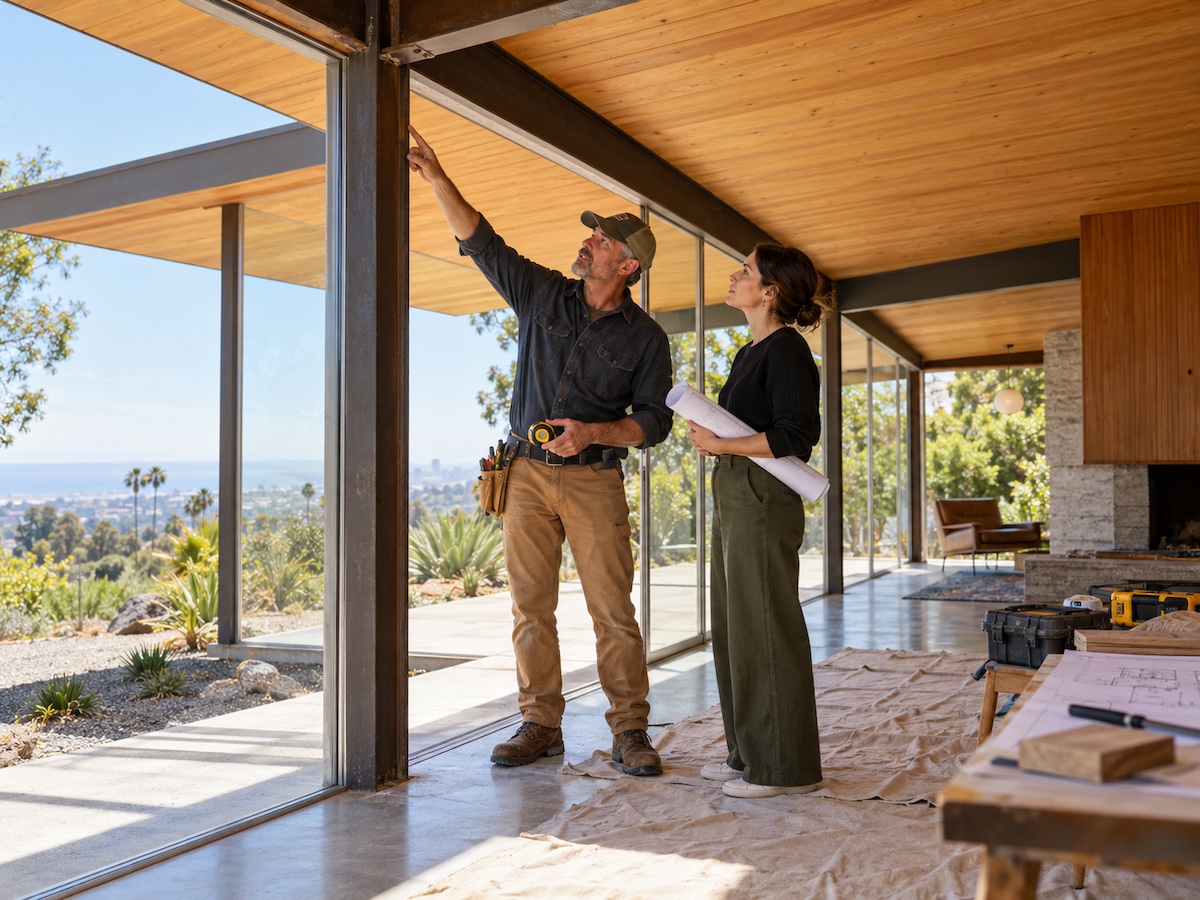
Most contractors are good at the houses they usually work on. A midcentury house is not that house. It has a concrete slab with pipes cast into it, a roof with no attic above, walls of glass held in thin steel or aluminum, and a wood ceiling that is also the roof deck. A crew that treats it like a newer tract house can do real damage in a day, and much of it will be to things that cannot be bought again.
So the headline is the whole test. You want someone who has done this work before, on a house like yours, and who can show you. What follows is how to find that person and how to check them.
A note on what this page is not. We do not yet publish our own list of approved contractors. We have not inspected anyone's work, and we will not vouch for a company we have not checked. What we can do is point you to the places where owners of these houses already trade names, and give you the questions to ask.
Start with the neighbors
The best lead is a finished job on your own street. Midcentury tracts were built by the hundred from a handful of plans, so the house three doors down very likely has your slab, your roof and your windows. If it has been restored well, someone knows how.
Ask who did the work, how long ago, and how it has held up. A ceiling that still looks right after five summers tells you more than any brochure. Home tours are useful for the same reason. Owners who open their houses have usually been through a restoration, and most are glad to say who helped and who did not.
Where to look, by region
Northern California. The Eichler Network keeps a Service Directory with more than 40 trade categories, from radiant heat and roofing to glass and paneling. It is organized by area: East Bay, Marin, Palo Alto, San Jose and Sunnyvale, San Mateo, San Francisco and Sacramento, with a section for Southern California. Read it for what it is. Companies pay a fee to be listed, and the Network says they must stay in good standing with the Better Business Bureau and the state license board. The Network also says plainly that it is not responsible for the work and that you should screen every company yourself. Treat it as a list of firms that want this kind of job, which is a real head start, and then do your own checking.
Palm Springs and the desert. The Palm Springs Modern Committee, the Palm Springs Preservation Foundation and Preservation Mirage are advocacy and education groups. Their tours and events, and Modernism Week each February, are where you meet owners who have just finished the job you are about to start.
Southern California. The Los Angeles Conservancy's Modern Committee, Modern San Diego and the Southern California chapter of Docomomo US cover the region from different angles.
The rest of the country. Docomomo US, the national group for modern architecture, has chapters in Chicago, Colorado, the District of Columbia, Florida, Georgia, Greater Philadelphia, Hawaii, Houston, Louisiana, Michigan, central Texas, Minnesota, St. Louis, New England, New York, North Texas, Northern California, Oregon, Western Washington and Wisconsin. Modern Phoenix and the Nevada Preservation Foundation do similar work in their states. The California Preservation Foundation and the National Trust for Historic Preservation are worth knowing as well.
None of these groups exists to recommend contractors, and you should not expect an official endorsement from any of them. What they have is members, and the members own houses like yours.
Check the license
In California, look up any contractor with the Contractors State License Board at cslb.ca.gov or by phone at 800-321-CSLB. Confirm that the license is active, that its classification matches the work, and that workers' compensation insurance is on file if the company has employees.
A license is required for almost any real job. A 2024 law, Assembly Bill 2622, raised the exemption for small jobs from $500 to $1,000 in combined labor and materials, starting January 1, 2025. The exemption applies only when the work needs no permit and the person doing it employs no one. Anything on a slab, a roof or a window wall will be well past that line.
Other states have their own boards and their own rules. Find yours and do the same check before you take a second meeting.
Questions to ask
How many houses like this have you worked on, and where? You want addresses, not adjectives.
Can I see one, and talk to the owner? The license board itself advises asking for references and looking at recent, similar projects.
How will you run new wiring or plumbing? There is no attic and no crawl space. A contractor who has done this before will have an answer ready. One who has not will pause.
What would you keep? A good answer begins with what stays: the original glass, the mahogany paneling, the ceiling boards. Be wary of a bid that begins with demolition.
Who will be on the job each day? The person who impressed you at the walk-through may not be the one holding the sander.
Who pulls the permit? It should be the contractor. If you are asked to pull it yourself as owner-builder, ask why.
Bids, contracts and money
These are California's rules, as the license board states them. Many states have something similar.
Get at least three bids, and make sure they cover the same scope, or you will be comparing prices for three different jobs.
The down payment may be no more than 10 percent of the contract price or $1,000, whichever is less. After that, do not let payments get ahead of the work that has been done.
Put everything in a written contract: the materials by name, the schedule, the cleanup. Any change should be a written change order signed by both of you before the work is done, not a conversation in the driveway.
Ask for proof of workers' compensation coverage for employees and of general liability insurance.
You have three days to cancel a home improvement contract after signing it, and five days if you are 65 or older.
Warning signs
The contractor prices a replacement before looking at whether a repair is possible.
You hear that nobody makes that part anymore. Sometimes it is true. Often someone does, or a shop can make it.
You are asked for a large deposit in cash, or told the job does not need a permit when it plainly does.
The company cannot name one comparable house it has finished.
If you do this work
Contractors and restorers who specialize in midcentury houses can list their services in our Market. A listing there is an advertisement placed by the company, not our endorsement, and everything above applies to it as well.