
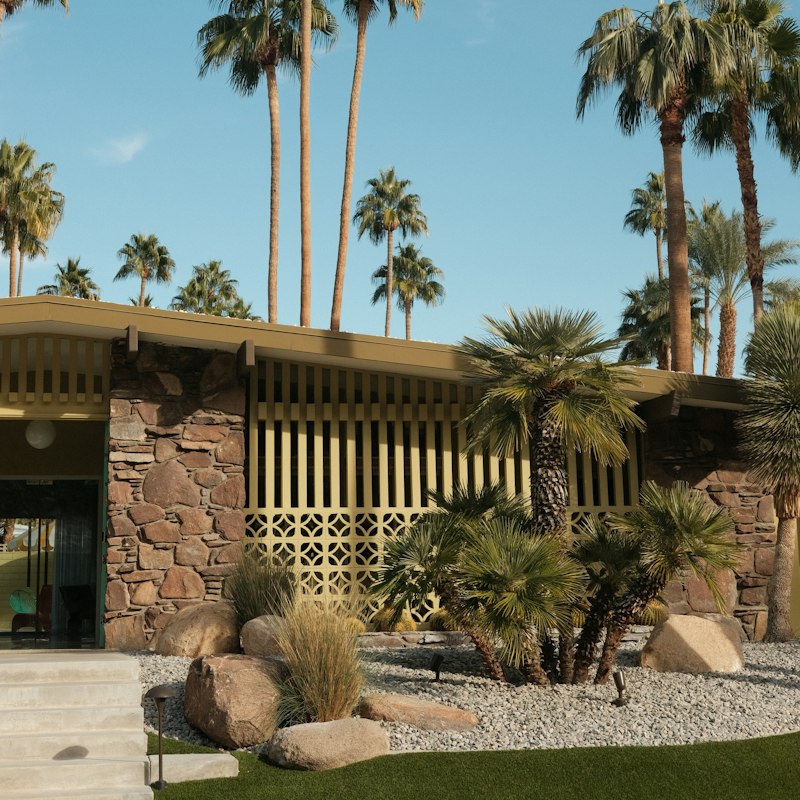
Drive through almost any neighborhood of 1950s ranch houses and count the colors. You will not need many fingers. Somewhere along the way the low, wide house that Cliff May gave to California was repainted a single safe shade, body, trim and front door alike, and most people now assume it was built that way.
It was not. May worked with color from his first house to his last, and the records show it. There is no single printed card that covers his whole career, or none that we could find. What survives is scattered: a scholar's account of his early houses, the files of a paint company, the sales literature for his tract houses and the paint still sitting under later coats on the houses themselves. Put together, they make a card.
1932: painted flowers and red tile
May was a San Diego bandleader with no architectural training when he finished his first house on February 27, 1932. It cost $9,500. The historian Mary van Balgooy, writing in the Journal of San Diego History, describes what he put into those early houses, and none of it is neutral.
The walls were coarse plaster and the roofs were red clay tile, laid a little unevenly on purpose. The floors were terracotta. The hardware and lanterns were black wrought iron. And on the wooden beams, the doors, the shutters and the cupboards, May had flowers painted by hand, in a manner she identifies as Mexican Art Deco. He furnished the rooms with Monterey-style furniture he had built himself and with Navajo rugs. By 1937 he had designed about fifty houses around San Diego, and the following year he moved to Los Angeles.
So the first entries on the card are these: white or cream plaster, terracotta, tile red, iron black, and bright painted ornament on the woodwork.
The 1940s: wood and garden
In Los Angeles the houses grew longer and plainer. Shingle roofs and board-and-batten walls joined the plaster and tile. Sunset magazine took up the cause, and its 1946 book Western Ranch Houses, which sold about 50,000 copies, drew 17 of its 43 designs from May.
The color of these houses came from materials more than paint: stained wood, plaster, brick, and a garden visible from every room. But paint was part of it. When Dunn-Edwards, the Los Angeles paint company, assembled a collection of historically documented colors, several of its ranch house entries were traced to the pages of Sunset between 1940 and 1955, and they include soft rose and pink tones alongside the expected browns.
1953: the tract houses
The houses most people mean when they say Cliff May are the ones he designed with Chris Choate for mass production. Rancho Estates in Long Beach, built in 1953 and 1954 for the developer Ross Cortese, has 700 of them. According to the Los Angeles Conservancy, they went up on a five-foot module from pre-cut parts, and four workers could assemble the basic structure in a day.
The exteriors were redwood board and batten. Inside were birch paneling and cabinets under an exposed beam ceiling. These were warm, brown, wooden houses with glass walls, and they were sold with color. Writing about the versions built in Denver, Modern In Denver reports that the builder offered buyers a set of coordinating colors, mostly earth tones, and left the decorating to them.
1955: the green
The most specific evidence is in May's own papers, which are held at the University of California, Santa Barbara. Dunn-Edwards says the files include notations and correspondence from 1955 recording a custom collaboration between May and the company. It produced a number of colors, and one of them was a soft grass green.
The company has reissued that green under the name Mow the Lawn, number DET520, in its Then, Now & Forever collection, a set of historic colors vetted by the preservation firm Architectural Resources Group. Dunn-Edwards says it has since been used on at least two May houses under renovation, one of them in Long Beach.
A grass green makes sense for a house whose whole purpose was to dissolve into its garden. It is also about as far from beige as a quiet color can get.
So what goes on the card
The research behind the Dunn-Edwards collection describes the typical ranch house scheme of the period this way: a body in natural earth tones or neutrals, with wood, stone and glass doing much of the work; trim in white, gray or brown; and bright accents, turquoise, orange and yellow among them, used in small amounts on panels.
Combine that with May's own record and the card reads like this.
Body: stained or natural redwood; warm earth tones; the soft grass green of 1955; white or cream plaster on the early houses.
Trim: white, gray or brown.
Roof and floor: clay tile red and terracotta on the early houses; weathered shingle on the later ones.
Accent: one bright color, used once. Turquoise, orange or yellow on a door or a panel, and on the early houses, painted ornament on shutters and doors.
Beige has a place here only as one neutral among several. What the record does not show is the house painted one pale color all over, which is what most of them are now.
How they went beige
No one decided it. Stained wood needs upkeep, and paint is easier. Each sale brought advice to choose something that would offend no buyer. Some board-and-batten walls were covered in stucco. After two or three rounds of this, the accent door, the dark trim and the green body were gone, and with them the contrast that made a long, low house look deliberate and not merely plain.
Find your own house's colors
The best color card for your house is the house. Original paint usually survives where later painters did not bother to scrape: under the eaves, behind a light fixture or the house numbers, inside a closet, on the back of a cabinet door.
Pick a hidden spot and sand a small circle gently through the layers until you reach bare wood. The rings that appear are the house's color history, with the oldest at the center. A paint store can scan a clean chip and match it.
One caution. A house built before 1978 may have lead in its paint, so use lead-safe methods: work wet, do not dry-sand large areas, and clean up carefully, or hire someone certified to do it.
Then test before you commit. Paint large samples on the shady side and the sunny side and look at them morning and evening. If the whole scheme feels like too much, start with the front door. One strong color on one door is the cheapest way to make a ranch house look like itself again.
A note on choosing
None of this obliges anyone to paint by the record. Doug and Rochelle Kramer, Realtors in Long Beach who specialize in May's houses, told Houzz that they struggled to find the right exterior color for their own 1953 house before settling, with a color consultant, on a calm gray-blue. That is not on any card from 1953, and it suits the house.
The point of knowing the original palette is not to obey it. It is to know that the house was drawn by someone who expected color, and to stop assuming that the absence of it is the safe choice.